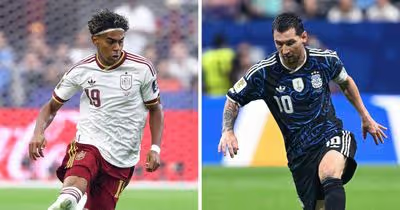
Argentina defend their World Cup crown against European champions Spain at MetLife Stadium in a 2026 final that doubles as attack versus defence and a generational showdown — 39‑year‑old Lionel Messi against 19‑year‑old Lamine Yamal — in the first South America vs Europe World Cup decider in six decades.
Spain vs Argentina — World Cup 2026 final preview
Spain and Argentina meet in the 2026 FIFA World Cup final at MetLife Stadium in New Jersey, a high‑profile clash that pits the tournament’s highest-scoring side against the stingiest defence.
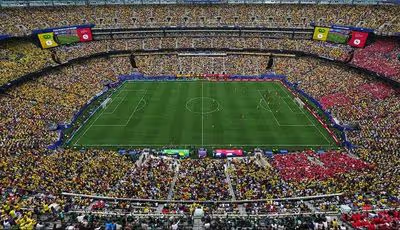
On paper it is a classic tactical duel: Argentina’s fluid, forward-heavy attack versus Spain’s possession discipline and defensive organisation.
Where and why this final matters
MetLife Stadium (rebranded for FIFA as New York–New Jersey Stadium) will host up to 82,500 fans for the title match. Beyond the trophy, this final matters because it reunites two continental giants — South America vs Europe in a World Cup final for the first time in 60 years — and because it may define Lionel Messi’s closing legacy against the spark of a new era in Lamine Yamal.
Key facts and context
Matches between Spain and Argentina: 16 total; Spain wins 6, Argentina wins 6, draws 2. Their only previous World Cup meeting came in 1966, an Argentina 2‑1 win.
Trophies underline the stakes: Argentina are three-time world champions (1978, 1986, 2022); Spain have one World Cup (2010) and are four-time European champions, including 2024. Argentina are dominant at the continental level with 16 Copa América titles, most recently 2024.
A statistical model used in the tournament places Spain as slight favourites, reflecting their defensive record and midfield control, but margins are narrow enough that match details will decide the winner.
Form and tournament stats
Argentina have been the tournament’s leading scorers with 19 goals, driven by Lionel Messi’s tournament haul. Spain have conceded just once across the competition, showcasing the backline and goalkeeper form that have frustrated the continent’s best attacks.
Mikel Oyarzabal leads Spain’s scoring in the tournament with five goals. Rodri has anchored Spain’s midfield, topping passing charts and offering control and tempo. For Argentina, Messi has been indispensable — combining goals and assists — with Lautaro Martínez and Enzo Fernández supplying secondary firepower.
Players to watch
Lionel Messi (Argentina)
At 39, Messi remains the fulcrum of Argentina’s attack. His combination of finishing, creative vision and set‑piece acumen has driven Argentina’s run. This final is both a farewell‑stage opportunity and a reminder that elite intelligence and timing still outpace pure athleticism in decisive games.
Lamine Yamal (Spain)
The 19‑year‑old winger is the tournament’s breakout story even after returning from injury without immediately finding full rhythm. Yamal changes angles, stretches defences and can force mismatches on the right — vital traits against Argentina’s often aggressive midfield pressing.
Rodri and Mikel Oyarzabal (Spain)
Rodri’s control of tempo and passing volume gives Spain the platform to suffocate opponents. Oyarzabal’s finishing and off‑ball movement provide the end product Spain need to convert territorial dominance into goals.
Lautaro Martínez and Enzo Fernández (Argentina)
Martínez supplies the physical centre‑forward presence to occupy defenders and finish chances; Enzo Fernández’s mobility and passing add balance between attack and midfield transition.
Tactical battlelines — what will decide the final
Ball progression vs counter threat: Spain will aim to dominate possession and work through midfield triangles, probing for openings. Argentina will seek transitions and overloads in wide areas to expose space behind Spain’s advanced lines.
Midfield control: If Rodri and Spain’s midfield retain first‑phase passing accuracy, they can limit Messi’s touches in dangerous areas. Conversely, Argentina’s ability to bypass the press with quick vertical passes will be crucial.
Set pieces and moments: With margins tight, dead-ball situations and individual brilliance from players like Messi or Oyarzabal could swing the match. Goalkeeping and defensive organisation will be decisive given Spain’s defensive record.
What the coaches bring
Spain’s coach has constructed a compact, possession-first system that prizes control and collective pressing. Argentina’s coach has built a flexible, attack-oriented side centred on Messi’s influence and an aggressive high-tempo approach.
Why this matters beyond the trophy
This final is a narrative crossroads: it could cement Messi’s status as the definitive great if Argentina retain the title, or mark the passing of the torch should Spain’s youthful blend topple the champions. It also showcases two stylistic schools — European possession control versus South American attacking fluidity — in a global, high-pressure setting.
Probable outcomes and immediate implications
A Spanish win would validate a defence-led tournament model and elevate this generation’s claim among Europe’s best. An Argentine victory would underline the enduring value of elite finishing and a transcendent player’s final flourish. Either result reshapes legacy conversations and will influence team planning ahead of the next international cycle.
Match regulations
If the final is level after 90 minutes, two 15‑minute periods of extra time will be played. If still tied, the match will be decided by a penalty shootout.
Bottom line
Spain vs Argentina is less about styles in isolation and more about which team imposes its identity under pressure.
Arsenal close to £100m-plus signing of Morgan Rogers after personal terms agreed
Expect a chess match of possession, moments of individual brilliance, and small margins deciding a historic final at MetLife Stadium.
 Al Jazeera