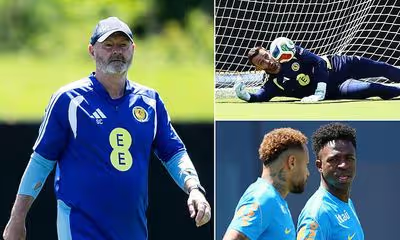
Steve Clarke faces renewed scrutiny after Scotland’s World Cup produced a 1-0 win over Haiti and a narrow defeat to Morocco that exposed a chronic shortage of clear chances. With Brazil looming in Miami, Clarke rejects the label of ultra-defensive coach, saying Scotland will chase a result and that pragmatic squad selection reflects available quality — but he admits the team must create more if it wants to progress from a brutal Group C.
Clarke under scrutiny after mixed World Cup start
Scotland sit on three points from two games — a scrappy win over Haiti and a defeat to Morocco — and questions have intensified over Steve Clarke’s tactical identity. Critics call him conservative; Clarke argues his choices are pragmatic responses to a limited pool of international-level attackers and one of the toughest group draws possible: Brazil and Morocco alongside Haiti.
Group C reality: Brazil, Morocco, Haiti
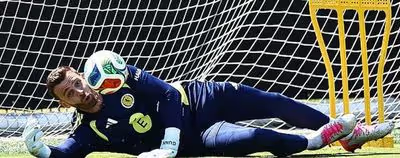
Scotland were the only third seed to draw two top-10 nations in their group, which immediately reframes expectations. A narrow loss to Morocco, after conceding in the opening minute, exposed Scotland’s fragility against pace and technical quality. The victory against Haiti produced only two shots on target, underlining a broader creative problem.
Why Clarke picked pragmatism over panache
Clarke defended his 26-man squad as the best available, including several Championship players and fringe club figures. That selection reflects depth realities rather than tactical timidity. Against Morocco he prioritised resilience after a calamitous start, a choice that kept Scotland competitive for long periods but did not produce the offensive spark required.
Tactical trade-offs: defence, possession and gamble moments
Clarke accepts the criticism that Scotland are “shot shy.” He’s clear this is not solved by wholesale attacking gambits that invite punishment. Instead he wants better control in the final third: longer possession, sharper passing and clearer, timed risks. That is a nuanced plan — keep a platform at the back but be purposeful when transitioning forward.
What the Morocco game revealed
The early concession forced Scotland into containment for the first phase, then a measured response. Late substitutions — Lyndon Dykes, Ross Stewart, Scott McTominay and Ben Gannon-Doak — signalled intent, but the team still failed to fashion a meaningful shot on goal. Clarke concedes that creating clear chances against top-10 opponents remains an urgent priority.
Players: leaders, under-fire stars and attacking options
John McGinn provided the decisive moments earlier in the tournament and remains central to Scotland’s creative engine. Scott McTominay has been pilloried by some but Clarke insists McTominay has fulfilled his role and deserves time to reclaim headlines. Strikers like Dykes and Ross Stewart are on hand, yet Scotland lack a consistently dangerous finisher at major-tournament level.
Bench and squad depth implications
The selection debate — notably around Oli McBurnie — highlights a thin margin between viable choice and perceived omission. Clarke’s reliance on Championship players and squad players from Celtic and Rangers is a pragmatic reflection of current form and fitness across the pool.
Brazil test in Miami: plan and prognosis
A point against Carlo Ancelotti’s Brazil would all but guarantee Scotland’s progression; a narrow defeat could still suffice. Clarke, however, frames the approach with ambition: “can we beat Brazil?” he asked, arguing a defensive, sit-back plan reduces the chance of even securing a draw. That is both a tactical and psychological posture: invite problems or force them onto a superior opponent.
Key matchups and players to watch
Brazil’s front line — including Vinicius Junior — will challenge Scotland’s defensive shape and quickness. Scotland must balance midfield protection with forward invention; McGinn and McTominay’s influence on transitions will be decisive. If Clarke’s team can hold possession higher and produce calculated gambles in the final third, they increase their odds of stealing points.
What this means and what comes next
Clarke’s reputation for caution is partly deserved but also over-simplified. His pragmatic selections and in-game choices reflect squad limitations and the quality of opposition. The immediate imperative is tangible improvement in chance creation. If Scotland can translate better possession and sharper passing into clear opportunities, they remain very much alive in Group C. Fail to do so, and tactical conservatism will look less like prudence and more like surrender.
Conclusion — measured ambition or missed opportunity?
Scotland’s World Cup campaign is far from over. Clarke’s insistence on attacking intent against Brazil is a necessary stance that acknowledges both the stakes and the optics.
Tom Brady: Argentina's World Cup threat comes from teamwork, not just Messi
The forthcoming Miami test will tell whether his pragmatism is a smart, survival-driven strategy or a coach’s safe play that ultimately limits what this group can achieve.
 Mail Online