Silvio Baldini has been appointed interim Italy head coach and has named a predominantly young 24-man squad for June friendlies against Greece and Luxembourg, calling on Gianluigi Donnarumma and Francesco Pio Esposito as the only senior additions. Baldini frames the fixtures as a chance to restore pride, accelerate youth integration and expose systemic club-level failures that are stunting Italy’s transition from U21 promise to senior success.
Baldini steps in as interim Italy coach, picks youthful squad for Greece and Luxembourg friendlies
Silvio Baldini has accepted the unexpected role of interim head coach for Italy and will lead the Azzurri into football matchs against Greece and Luxembourg in early June.His 24-man call-up leans heavily on the U21 core he already knows, with only Gianluigi Donnarumma, Marco Palestra, Niccolò Pisilli and Francesco Pio Esposito having senior caps.
Immediate context: why Baldini, and why this squad?
Baldini was appointed following the resignation of the previous manager after Italy failed to progress in the World Cup play-offs.He makes no secret that this is a short-term assignment, yet he views the fixtures as more than low-stakes friendlies: they are a platform to fast-track young talent, test continuity with the U21s and send a message about the type of football he wants Italy to embody.
What Baldini said — the message and the method
Baldini emphasised meritocracy and collective pride.He admitted he lacks the traditional CV many expect of a senior national coach, but argued his U21 experience and rapport with these players justify the selection.He called for strict professional standards — nutrition, recovery, discipline — and prefers to remove players who violate team principles rather than levy fines.
Why Donnarumma and Esposito were added
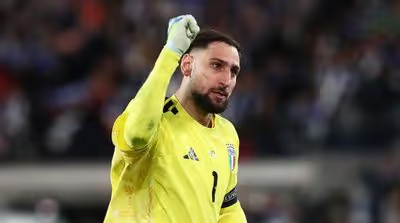
Only Donnarumma reached out to offer availability after the national team’s recent setback, and Baldini accepted his participation along with Pio Esposito.Those two represent a bridge between youth and senior levels and could factor into Olympic considerations.Baldini says he deliberately limited senior inclusions to preserve the developmental focus and continuity of the U21 cohort.
Reading between the lines: Baldini’s critique of Italian club culture
Baldini was pointed about the structural issues holding Italian football back.He blamed club directors for prioritising short-term transfer market gains and older recruits over academy development, describing a systemic reluctance to hand sustained minutes to young players.This cultural diagnosis explains the perennial problem: Italy’s youth teams perform well, yet the domestic pathway to regular Serie A minutes remains clogged.
Why that matters
Without meaningful minutes at club level, young prospects stall at the senior transition.The consequence is slower match tempo, less intensity and ultimately a national team that struggles to inject rhythm and pace.Older squads manage games rather than drive them; Baldini points to clubs that trust youth and play more aggressively as models worth emulating.
Tactics, temperament and what to expect in June
Baldini wants players who bring energy, speed and cohesion.He stresses unity and mutual support: his squad culture is described as “healthy,” players enjoy being together and are willing to sacrifice for the team.Those traits matter more in friendlies where building identity and confidence are the primary objectives.
On-field priorities
Expect Italy to prioritise quick transitions, higher tempo and pressing from young attackers conditioned to play with intensity.Baldini’s emphasis on rules and recovery signals a more professionalized camp aimed at extracting maximum performance from short preparation windows.
Risks, rewards and the bigger picture
There is a measurable risk: poor results could further dent Italy’s FIFA ranking and public confidence.However, Baldini argues the psychological cost of assuming defeat is greater than the ranking risk; he insists on backing the players to win and to play with freedom.
Longer-term implications
These friendlies double as an audition — not just for players but for the national program’s future direction.If the youthful core impresses, it strengthens the case for a youth-first rebuild and pressures clubs to accelerate player development.Conversely, failure would likely accelerate the search for a high-profile permanent coach and could validate conservative club transfer strategies.
Who should be the next permanent coach?
Baldini declined to endorse specific names but argued the permanent appointment should be someone with a strong resume and proven capacity to influence both style and development.He stressed the incoming coach should not view his interim work as an obstacle; on the contrary, Baldini expects to leave a coherent, ambitious group for his successor.
Bottom line: a calculated reset, not a gamble
Baldini’s appointment is less a fluke than a tactical reset: short-term stewardship with a strategic thrust toward youth integration and cultural change.Baldini’s blunt assessment of club leadership is uncomfortable but necessary; if Italy is to reclaim its identity, it needs more clubs willing to trust and play their best young talents.
Liverpool have buy-back option on £70m trio while Manchester City keep tabs on £37.5m summer sales
For now, these friendlies are both a test for the players and a referendum on whether Italy is ready to trade short-term security for a faster rebuild.
 Football Italia