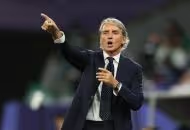
Roberto Mancini has been reappointed Italy head coach, returning after a three-year absence to rebuild the Azzurri ahead of the next major tournament. The FIGC also named Claudio Ranieri technical director, replacing Paolo Maldini. Mancini’s return reunites Italy with the Euro 2020-winning architect whose record unbeaten run and attacking overhaul are weighed against past failures, notably missing the 2022 World Cup.
Roberto Mancini returns as Italy head coach
Roberto Mancini is officially back in charge of Italy, ending a three-year separation from the national team. His previous stint ran from July 2018 to August 2023 and produced the Euro 2020 title and a globally admired attacking identity. The Italian Football Federation (FIGC) reorganized the leadership, appointing Claudio Ranieri as technical director in place of Paolo Maldini.
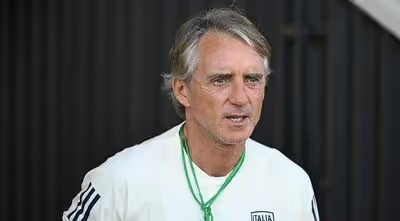
Why the FIGC brought Mancini back
Mancini’s reappointment signals a desire for immediate credibility and identity. He rebuilt Italy after the 2018 World Cup absence, restoring belief with high-possession, forward-thinking football and tangible success at Euro 2020. The federation appears to prioritize a proven architect who can reassert Italy’s stylistic and competitive standards quickly.
Experience and a ready-made philosophy
Mancini’s tactical blueprint is familiar to players and staff, reducing transition friction. His emphasis on ball progression, positional rotation and attacking fluidity fits a generation of Italian talents now emerging in top leagues. Retaining or reintroducing that framework should accelerate cohesion.
Track record: triumphs and shortcomings
Mancini’s Italy delivered 38 wins, 12 draws and eight defeats in his prior tenure, including a world-record unbeaten run of 38 matches — a sequence later surpassed by Spain. Yet his résumé is double-edged: the Euro 2020 triumph contrasts sharply with the failure to qualify for the 2022 World Cup after a play-off loss to North Macedonia.
What his record tells us
The numbers show a coach capable of sustained success and identity-building, but also vulnerability in high-stakes qualification scenarios. That inconsistency will be a key narrative: can Mancini translate tournament-winning form into reliable qualification and knockout performance?
Tactical implications and squad management
Mancini’s return likely means a recommitment to attacking structure and tactical versatility. Expect a focus on integrating emerging forwards and versatile full-backs while balancing defensive solidity — historically the area that required shoring up under his watch.
Player pathways and selection signals
Mancini favors form and adaptability, rewarding players who fit his possession model. That could benefit Italy’s crop of international-based talents and prodigious youngsters, but it also raises selection dilemmas where experience and physicality clash with tactical fit.
Claudio Ranieri as technical director: stability and structure
Naming Claudio Ranieri technical director introduces a pragmatic, experienced voice at federation level. Ranieri’s long managerial career offers institutional knowledge and a steadying influence on recruitment, youth development and coach–management relations. Replacing Paolo Maldini signals a structural shift toward managerial oversight rather than purely former-player representation.
What this means for Italy’s near-term prospects
Mancini’s immediate task is twofold: reestablish consistent qualification form and prepare a squad capable of competing at the next major tournament. His track record suggests he can restore identity and morale quickly, but the federation will judge success by reliable qualification and deeper tournament progress, not nostalgia.
Risks and checkpoints
Key risks include repeating past qualification lapses and failing to adapt tactics against physical, direct opponents. Early qualifiers and Nations League fixtures will act as indicators: improved defensive organization and sharper finishing will be the clearest signs of progress.
Conclusion — why this appointment matters
Rehiring Mancini is a decisive, short-term winning move by the FIGC: it brings back a coach with proven success and a clear footballing philosophy. The challenge now is converting charisma and style into consistent results.
If Mancini combines his attacking vision with tougher qualification management, Italy can regain its place among Europe’s elite; if not, criticism that ended his last term will resurface quickly.
 Football Italia