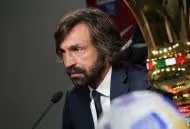
Andrea Pirlo is poised to be announced as Italy’s next head coach after Carlo Ancelotti and Pep Guardiola reportedly declined the role; a four-year deal through the 2030 World Cup with a reported €1.5m annual salary is ready, pending resolution of his current contract with UAE side United FC and a formal FIGC meeting early next week.
Andrea Pirlo set to become Italy head coach — key facts
Andrea Pirlo is the clear favorite to take charge of the Italy national team, with an announcement expected after the FIGC’s upcoming meeting. Reports say the deal spans four years, taking the Azzurri to the end of the 2030 World Cup, and carries a modest reported salary of around €1.5m per season.
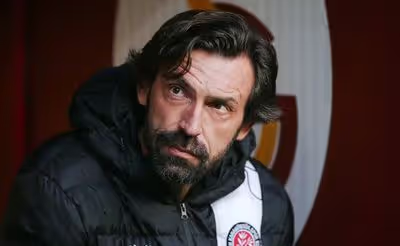
Paolo Maldini and Leonardo are understood to have been the primary contacts in convincing Pirlo, drawing on established relationships from their Milan years. Before confirmation, Pirlo must resolve his current contract with UAE side United FC by mutual consent.
Why Pirlo emerged after Ancelotti and Guardiola declined
Carlo Ancelotti and Pep Guardiola were reportedly approached earlier in the process but opted against the Italy job. Those refusals left the federation searching for a candidate who could accept a long-term rebuilding brief on pragmatic financial terms — criteria Pirlo appears to meet.
The technical director model, with Maldini in a leading role, changes the dynamics of the appointment. The FIGC’s creation of that post means the federation’s decision is now more collaborative, and Pirlo’s appointment reflects both coaching potential and alignment with the federation’s strategic direction.
Contract and timing: what to expect
A formal presentation is likely early next week once contractual details with United FC are settled and the FIGC convenes. The reported four-year horizon signals an intent to give the new coach continuity through qualification cycles and the 2030 World Cup.
The salary figure being quoted is modest by elite coaching standards, which helps explain why higher-profile names turned it down. That financial reality shapes not just the appointment but expectations around squad rebuilding and resource allocation.
What Pirlo brings and what he must prove
Pirlo arrives with big-name prestige and a modern footballing philosophy tied to his playing career. But his managerial résumé remains limited at the highest level, which turns this into a calculated gamble for Italy.
Tactically, Pirlo has shown an affinity for possession and progressive attacking patterns. Translating that into international consistency — with condensed windows and high-pressure qualifiers — will be the immediate test.
Squad management and long-term vision
The Azzurri are at a crossroads: ageing stalwarts, fresh talent coming through, and tactical identity in need of clarity. Pirlo’s remit appears to be medium- to long-term: re-establish Italy as a major force by molding a coherent playing style and integrating young prospects.
With Maldini and Leonardo shaping recruitment and broader strategy, Pirlo can focus on coaching and tactics. That division of labor could help mitigate his relative inexperience, provided the technical leadership remains aligned.
Risks, opportunities and next steps
Risk: limited elite managerial experience and the pressure of immediate results in qualifiers and tournaments. Opportunity: a unified project with technical backing and a clear time horizon through 2030.
Next steps are procedural: mutual termination with United FC, FIGC ratification, and a public presentation. After that, attention turns quickly to squad selection, staff appointments, and the tactical identity Pirlo will impose on a team hungry to reclaim its international standing.
Why this matters for Italy football
This appointment signals a strategic pivot: a willingness to back a younger coach with a long-term mandate rather than buy short-term prestige. If successful, Pirlo could reset Italy’s trajectory; if not, the federation will face scrutiny for choosing potential over proven pedigree.
Tzolis at Arsenal: How the record Greek signing can avoid past pitfalls
Either way, the next 12–24 months will define whether this choice was bold foresight or an avoidable risk.
 Football Italia