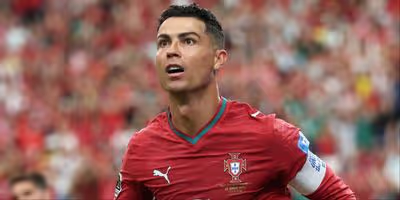
Cristiano Ronaldo has reignited the World Cup vs. European Championship debate by insisting Portugal’s Euro 2016 triumph “carries the same dimension” as lifting the World Cup. His declaration, coming as he confirms the 2026 tournament will be his last, reframes the discussion from pure prestige to emotional and historical impact — forcing a fresh look at how national milestones shape a player’s legacy.
Ronaldo’s claim: Euro 2016 equals a World Cup?
Cristiano Ronaldo has publicly argued that winning Euro 2016 for Portugal holds the same significance as lifting the World Cup.
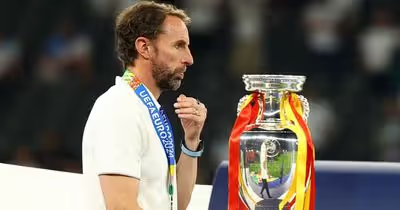
That assertion isn’t mere bravado: it’s rooted in the context of ending a decades-long trophy drought for Portugal and delivering the nation’s first major international title with him at the center.
Why Ronaldo’s comparison resonates
Winning Euro 2016 transformed Portugal’s football narrative. For a country that had repeatedly fallen short on the biggest stages, that triumph altered public memory and national pride. For Ronaldo, who has been the face of Portuguese football for two decades, the emotional weight of that achievement is understandable — it changed how Portugal is viewed and ended a collective impatience that had hung over generations.
Why many still see the World Cup as supreme
The World Cup’s claim to being the pinnacle stems from scale and inclusivity: it is the global tournament that pits all confederations against each other and captures a worldwide audience in a way no continental event can fully match. Prestige, historical continuity and global reach are the hallmarks that keep the World Cup at the top of football’s pecking order.
Comparing the competitions: quality, reach and stakes
There are three practical lenses for comparison: competitive intensity, global reach, and stakes.
Competitive intensity
Europe concentrates many of the world’s finest teams, so on a match-by-match basis the Euros often deliver elite matchups. That concentrated quality supports Ronaldo’s point that beating top European opponents repeatedly is a significant test. Still, the World Cup introduces non-European powers—South American heavyweights among them—which alters tactical demands and diversity of opposition.
Global reach and cultural impact
The World Cup remains the unmatched global spectacle. It unites disparate football cultures and produces moments watched by billions. The European Championship is massive in reach and impact—especially across UEFA nations—but its continental scope inherently limits its universality.
Financial and institutional stakes
Prize pools and commercial weight tilt in favor of the World Cup, which tends to carry larger financial rewards and greater institutional attention. That matters for federations and the sport’s global footprint, even if it is secondary to players and fans who equate trophies with legacy.
What this means for Ronaldo’s legacy
Ronaldo framing Euro 2016 as equivalent to a World Cup is an exercise in legacy management as much as pride. It reframes his international résumé: three major titles with Portugal, emotional leadership and a country-altering triumph. For defenders of his case, the measure of a player’s greatness includes the tangible uplift they bring to their nation, not just a checklist of trophies.
Limits of the argument
Objectively, most observers will still rank a World Cup triumph above a continental title. Historical precedent, global viewership and the symbolic title of “world champion” are hard to erase. Ronaldo’s statement doesn’t change those facts, but it does demand that analysts account for the qualitative difference between objective prestige and personal or national significance.
Wider implications for Portugal and the 2026 World Cup
For Portugal, Euro 2016 remains a defining achievement and a blueprint for success: infrastructure, belief and tactical cohesion that can be replicated. For players and fans, it raised the bar and expectations heading into global tournaments. With Ronaldo signalling 2026 as his last World Cup, the conversation shifts: will Portugal translate continental success into a genuine World Cup challenge before his exit?
Conclusion
Ronaldo’s claim is provocative but sensible when viewed through the prism of national impact and personal legacy. It does not dismantle the World Cup’s unique global status, but it forces a fuller appreciation of why some trophies matter differently to different people.
FIFA opens probe into Argentina after post-final clashes and semi-final banner
The debate is less about binary ranking and more about how sporting moments reshape nations, careers and history.
 Givemesport