Barcelona's decision to invest roughly £69m in Anthony Gordon is under harsh scrutiny after lacklustre World Cup displays and a benching that opened the door for Marcus Rashford. With Thomas Tuchel juggling options on the left and comparisons to Lamine Yamal mounting, the club's financial gamble and tactical choices now carry immediate consequences for Gordon's future at Camp Nou.
Gordon's World Cup struggles put Barcelona's summer gamble in the spotlight
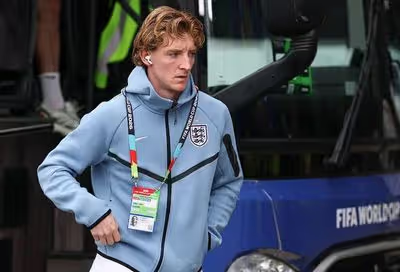
Barcelona's summer signing Anthony Gordon has faced sharp scrutiny after unconvincing performances at the World Cup. Signed for around £69.3m (roughly €80m), Gordon arrived with expectations that his energy and crossing would bolster the left flank; instead, ineffective showings and limited attacking influence have intensified questions about the club’s recruitment strategy and the size of the outlay.
What happened on the pitch
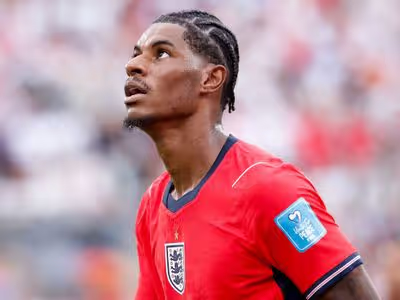
Thomas Tuchel persisted with Gordon early in the tournament, selecting him ahead of Marcus Rashford for the Group L opener against Croatia. Gordon struggled to impact games, prompting Tuchel to introduce Rashford from the bench, who later added the match-sealing fourth goal. Gordon again failed to impose himself against Ghana and was left out of the start against Panama, where Rashford took the role instead.
Media and fan reaction — why the transfer is being questioned
Spanish media and supporters have voiced concern that Barcelona spent heavily on a player who has yet to deliver on football's biggest stage. Criticism focuses less on attitude and more on output: limited end product from the left wing, visible hesitation when accelerating attacks, and the psychological weight of a big transfer fee. Those factors combine to amplify scrutiny and expectations at a club already navigating financial constraints.
Performance analysis: strengths, weaknesses and missed moments
Gordon's defensive work has received some recognition — his willingness to track back fits Barcelona's current demands for structure on the flanks. However, his attacking footprint has been underwhelming: low shot involvement, few progressive runs that break lines, and limited end-zone deliveries. For a player bought to provide width, creativity and goals, the sample from the World Cup raises legitimate questions about whether he is the optimal profile for Tuchel’s system at Camp Nou.
Why Rashford's impact matters
Marcus Rashford's effectiveness when brought on exposed an immediate contrast. Rashford showed directness, better end-product and an ability to influence the final third — attributes Barcelona clearly felt they needed. Whether Rashford was a genuine transfer target and why he wasn't pursued is now less important than the tactical reality: Barcelona need consistent end-product from the left, and Rashford temporarily provided that.
Tactical fit and internal competition for the left wing
Barcelona’s left flank is no longer a settled position. Lamine Yamal sets the benchmark on the opposite side; being compared to one of the game's brightest teenagers is a harsh measure for any new arrival. Beyond Rashford, alternatives like Eberechi Eze or Morgan Rogers are being considered conceptually for rotation or stylistic change. The coaching staff must decide if Gordon can adapt his attacking output to meet LaLiga and European demands or whether different profiles better suit Tuchel’s preferred patterns.
What Tuchel’s selections reveal
Tuchel’s initial faith in Gordon suggested the manager valued specific attributes — perhaps workrate, defensive balance or training form. But the swift switch to Rashford and Gordon’s subsequent omission shows a pragmatic approach: match-day effectiveness will override transfer narratives. That sets a clear message internally — performances, not price tags, will dictate selection.
What this means for Barcelona going forward
The situation has pragmatic and reputational dimensions. Practically, Barcelona must resolve who provides reliable attacking output on the left or risk tactical imbalance. Financially and reputationally, a high-fee signing underperforming at a global tournament invites uncomfortable comparisons and heightens pressure during the integration phase.
Likely next steps
Short term: expect rotation and tactical tinkering. Gordon will receive opportunities but must convert training promise into measurable attacking contributions — goals, assists, progressive carries.
Medium term: if performances don't improve, Barcelona could pivot to alternate options or tweak systems to lessen the dependency on Gordon’s direct output.
Long term: adaptation to club patterns and rebuilding confidence will be essential if the transfer is to be judged a success rather than a costly gamble.
Bottom line
Barcelona’s gamble on Anthony Gordon has quickly become a talking point because elite-level returns are expected from big-money signings. The World Cup exposed short-term vulnerabilities, but it does not definitively close the book on Gordon.
Scholes urges Man Utd to pursue Sandro Tonali and give Mainoo World Cup minutes
The coming weeks at Camp Nou will determine whether he adjusts and justifies the fee or whether the club must rethink personnel and tactics to secure consistent attacking firepower on the left.