Real Madrid has long treated the World Cup as a global transfer fair, turning tournament form into marquee signings from Didi and Paul Breitner to Ronaldo, Mesut Özil and Thibaut Courtois. That strategy has delivered iconic successes and embarrassing misfires, underlining both the value and danger of buying on World Cup momentum.
Why Real Madrid targets World Cup performers
Real Madrid scouts the World Cup because the tournament compresses pressure, quality and visibility into a brief window. Strong performances there can prove a player's temperament on football's biggest stage — a trait the Bernabéu demands. But a condensed sample can also inflate value: a handful of standout matches does not guarantee season-long consistency in La Liga or the Champions League.
World Cup-to-Bernabéu signings: the hits and misses
Didi — 1958
Didi arrived off Brazil’s 1958 triumph and a Golden Ball, but his spell at Madrid lasted only a year amid dressing-room friction. A reminder that world-class talent does not always equal the right fit.
Paul Breitner — 1974
Breitner came after West Germany’s 1974 campaign and delivered tangible success: two La Liga titles in three years. A classic example of a World Cup profile that translated into consistent club impact.
Gheorghe Hagi — 1990
Hagi’s Italia 90 showed his star quality and prompted a high-profile move. Creativity and brilliance were intermittent at Madrid; he never matched his best Romania years. Talent alone couldn’t paper over tactical mismatches.
Predrag Spasić — 1990
Spasić’s arrival after a strong World Cup run with Yugoslavia failed spectacularly. Restricted foreign slots and poor adaptation saw him depart after one season, an illustration of administrative and scouting miscalculations.
Robert Jarni — 1998
Jarni impressed at France 1998 but lasted a single season at the Bernabéu. His transfer saga also highlighted how convoluted deals can precede underwhelming returns.
Ronaldo — 2002
Ronaldo is the model payoff: Golden Boot in Korea/Japan, a €46m move and instant global superstar status. He scored 104 goals in 177 games and helped restore Madrid’s attacking swagger — a World Cup-to-club story that worked brilliantly.
Fabio Cannavaro — 2006
At 33, Cannavaro arrived after captaining Italy to World Cup glory and winning the Ballon d’Or. For a modest fee he steadied Madrid’s defence and won two La Liga titles — a low-risk, high-reward veteran signing.
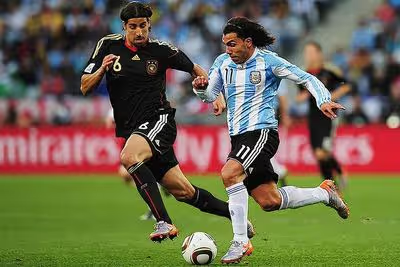
Mesut Özil — 2010
Özil exploded onto the scene in South Africa and was signed for creative control. He became a prolific assist provider and a key figure in Madrid’s 2011–12 La Liga title, though critics later questioned his consistency in big moments.
Sami Khedira — 2010
Khedira complemented Özil after the same World Cup and provided the engine in midfield. Less flashy but dependable, he stayed longer and collected a Champions League medal in 2014 — the kind of pragmatic addition Madrid values.
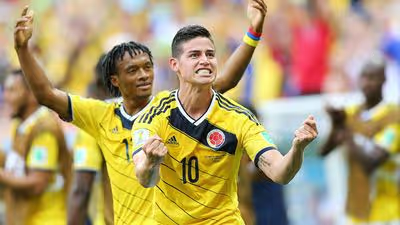
James Rodríguez — 2014
James’s 2014 World Cup volley and Golden Boot made the transfer inevitable. Moments of genius at Madrid were offset by irregularity and a crowded attacking roster. A reminder that flair must fit a tactical blueprint to last.
Thibaut Courtois — 2018
Courtois won the Golden Glove in Russia and moved from Chelsea for a fee that now looks like value. He’s become one of Madrid’s best modern goalkeepers, cementing the argument that elite tournament form can point to long-term reliability.
What this pattern means for Real Madrid and future transfers
Real Madrid’s World Cup recruitment yields big hits and conspicuous misses because the club prizes immediate impact and global profile. Successful conversions — Ronaldo, Courtois, Cannavaro, Breitner — combined tournament form with tactical fit and mental resilience.
Failures often came from rushed evaluations, squad overcrowding or foreign-player rules of past eras. Going forward, Madrid must keep balancing headline-grabbing signings with rigorous tactical vetting. The World Cup will remain a scouting goldmine, but the smartest deals will pair standout tournament performances with clear plans for integration.
Final takeaways
The World Cup is a powerful accelerator for transfers, but it is not a guarantee.
The quiet Americanization of soccer: US owners now control some of Europe’s biggest clubs
Real Madrid’s history shows that club structure, coaching clarity and realistic expectations determine whether a World Cup star becomes a Bernabéu legend or a cautionary tale.
 Si
Si