Breaking: UEFA, joined by Concacaf and the AFC, is threatening to boycott future FIFA tournaments after Gianni Infantino proposed selling minority stakes in FIFA competitions to private investors — a move that risks stripping the World Cup of Europe’s elite, triggering a commercial and sporting crisis and forcing a high-stakes governance showdown in world football.
UEFA threatens boycott after Infantino’s minority-stake proposal
Gianni Infantino’s plan to sell minority equity in FIFA competitions has provoked an unprecedented backlash from UEFA and other confederations. The proposal, framed by FIFA as a way to unlock new revenue and investment, has been met with fierce opposition from European federations who argue the World Cup is not an asset to be partly privatized.
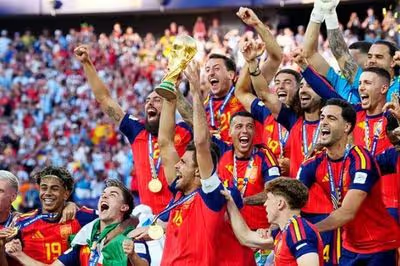
Concacaf and the AFC have publicly expressed similar concerns, amplifying the threat of coordinated withdrawal.
Why a European boycott would be seismic for the World Cup
UEFA supplies many of the tournament’s most marketable teams and highest-value players. A boycott by European nations would remove fixtures that drive broadcasting numbers, diminish global interest and challenge the World Cup’s claim as football’s definitive global competition. At the 2026 World Cup, 16 of 48 slots were European — a comparable withdrawal in 2030 would dramatically alter tournament quality and narrative.
Sporting identity at stake
Historic rivalries — France vs. England, Spain vs. Germany, Portugal vs. France — underpin the World Cup’s allure. Removing Europe’s elite dilutes competitive integrity and robs fans of marquee matchups. For players, especially those for whom World Cup appearances are career-defining, a boycott would be a lost, sometimes once-in-a-lifetime opportunity.
Commercial fallout: broadcasts, sponsors and valuation
Broadcasters and sponsors pay premium fees for rights tied to star players and top European markets. Excluding UEFA teams would erode television audiences across key territories and weaken sponsorship propositions, reducing bargaining power and revenue for FIFA and national associations. The financial damage would cut both ways: FIFA risks lower tournament valuations; UEFA members forego prize money and global exposure.
Who would feel the pain?
Global audiences, sponsors and broadcasters would immediately feel the impact. Domestic federations lose income and exposure. Clubs and player valuations could be affected indirectly as international platforms shrink. While short-term losses would be most visible for FIFA, long-term fragmentation would threaten the sport’s unified commercial architecture.
Governance and legal implications
The dispute signals a deeper tug-of-war over who controls football’s most valuable products. Selling stakes in competitions raises governance questions: who sets commercial terms, how revenues are shared, and what protections exist for member associations. Legal challenges, regulatory scrutiny and national association pushback are now realistic outcomes if talks falter.
Power politics versus revenue logic
This is as much about control as it is about cash. UEFA’s resistance reflects concern that private investment could shift power away from member associations and toward external stakeholders prioritizing profit over sport. The standoff exposes tensions between FIFA’s pursuit of new revenue models and confederations defending competition integrity.
Historical context: boycotts are rare but consequential
Football has seen withdrawals and boycotts before — political protests and disputes over allocation of places have led teams to abstain from tournaments. But never has a confederation as influential as UEFA threatened mass non-participation over a governance and commercial decision. The scale and commercial sophistication of modern football make this confrontation uniquely dangerous.
Immediate effects on upcoming tournaments
The dispute already casts a shadow over future events, including the 2026 World Cup legacies and the 2027 Women’s World Cup. European powerhouses like Spain and England add significant sporting and commercial value to these tournaments; their absence would force FIFA and host nations to rethink marketing, scheduling and host guarantees.
Women’s game vulnerability
The Women’s World Cup benefits from growing European participation and fan engagement. A boycott or prolonged rift could stall momentum for women’s international football, threatening investment flows and media growth at a fragile moment for the game.
What happens next: negotiation, votes and possible escalation
Expect intense behind-the-scenes talks between FIFA, UEFA and other confederations, with potential attempts to amend the proposal or offer protective governance mechanisms. FIFA’s executive bodies will face pressure to clarify commercial structures, revenue distribution and safeguarding provisions. If negotiations fail, coordinated confederation actions — from legal challenges to formal threats of non-participation — could follow.
Scenarios to watch
A negotiated compromise would likely include stricter governance safeguards and revenue guarantees for member associations. A unilateral push by FIFA risks a political impasse and reputational damage. Neutral arbitration or involvement from wider football stakeholders may be needed to defuse the crisis.
Why this matters beyond money
At its core, the conflict is about the future shape of international football: who owns its competitions, who benefits from growth, and how the game balances commercial ambition with sporting values. The outcome will set a precedent for future deals and determine whether football’s flagship tournaments remain primarily member-driven or increasingly subject to external investment logic.
Bottom line
This is a governance crisis with immediate sporting and commercial consequences. A European-led boycott is not inevitable, but the dispute has exposed a fragile consensus around how football is monetized and governed.
Can a 64-team World Cup work? FIFA orders review ahead of 2030 centenary
How FIFA and UEFA navigate the next weeks will determine whether the World Cup remains the unifying pinnacle of the sport or fractures into competing visions of football’s future.
 Sports Mole