
Brendan Sorsby's petition to enter the NFL via the supplemental draft has been denied, the league citing significant integrity concerns and insufficient time for review—forcing him to wait for the next spring draft and likely prompting legal action. The decision reshapes a rarely used pathway into the pros and raises questions about consistency and precedent.
NFL denies Brendan Sorsby’s supplemental-draft bid, sets up legal fight
The league rejected transfer quarterback Brendan Sorsby’s request to enter the NFL through the supplemental draft, saying the matters raised are too significant to vet within the expedited timeline. The decision leaves Sorsby in limbo: he cannot sign with any team as an undrafted free agent until the next spring draft is complete.
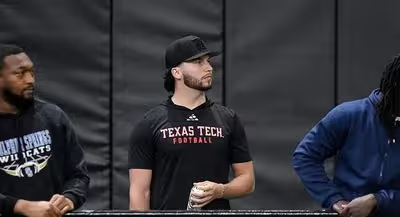
The league framed the move as a matter of protecting institutional integrity while acknowledging the supplemental process is not designed for complex cases. Sorsby’s camp has signaled it will challenge the ruling and seek union intervention, setting up a labor-and-legal storyline that could test supplemental-draft practices and the NFLPA’s appetite for confrontation.
Why this matters This is more than a single-player chronology. The supplemental draft is an exception route that has historically been used sparingly and inconsistently, creating win-loss precedent for both players and the league. Denying Sorsby now establishes a higher bar for entrants who seek an expedited review, particularly when the league believes the facts implicate core integrity concerns.
H2: What past supplemental drafts tell us Teams have previously accommodated players through supplemental picks in unique circumstances: disciplinary suspensions, eligibility rulings and off-field investigations have all factored into decisions. Those past thresholds will now be scrutinized against the Sorsby outcome, and teams evaluating borderline prospects must factor in the possibility of a protracted eligibility battle.
Practical fallout for Sorsby and NFL teams
Teams that might have considered an immediate, low-risk evaluation now must wait. For Sorsby, the only immediate pathway is to prepare for the regular draft cycle next spring. For the league, the decision invites legal and public scrutiny about fairness and how integrity standards are applied — particularly when other players with significant past issues made it to the draft in prior years.
Harry Kane’s NFL flirtation highlights a rare cross-sport pipeline
Harry Kane’s public curiosity about trying American football — specifically a conversion route similar to Brandon Aubrey’s path from professional soccer to NFL kicker — continues to make headlines. Kane, a prolific striker in his mid-30s, is widely admired for work ethic and consistency, traits that scouts covet for specialist roles.
Why the pathway is narrow There are only 32 kicker jobs in the NFL. Even elite soccer pedigree and global stardom won’t guarantee one of those slots. The Aubrey blueprint shows it’s possible, but it also underlines how limited the market is and how much coaching, specialist training and positional acclimation would be required.
Antonio Freeman’s son scores for USMNT at the World Cup
Alex Freeman’s strike on the World Cup stage delivered an emotional moment for his father, former All-Pro Antonio Freeman, and marked a rapid emergence for the 21-year-old winger. Scoring for country changes a young player’s narrative; it fast-tracks visibility and forces evaluators in both club and national setups to adjust expectations.
What it suggests about development The Freeman story reinforces how modern pathways and sporting lineage can intersect to accelerate a player’s rise. For U.S. Soccer, producing impact performers on a global stage signals depth in youth development that matters for future tournament cycles.
Modern GM profile and team-building trends
The ideal general manager in 2026 is less a lone scouting savant and more a synthesizer of data, personnel, and organizational process. Successful franchises will prioritize leaders who can integrate scouting, analytics, salary-cap strategy, and culture-building into repeatable systems — not just find one-off talent.
What teams should change Organizations should value leadership, process design and cross-department collaboration alongside traditional player evaluation. Ownership that empowers a modern GM to build infrastructure will likely enjoy more sustainable success than teams that continue to treat the role as purely talent-spotting.
Offseason and camp notes to watch
Blake Corum and other young Rams are emerging as players to track as the team transitions to its next core. Cleveland’s revamped receiver room has drawn early praise, with a rookie making particularly strong impressions in spring practices. Training-camp schedules are set across the league — a reminder that evaluations accelerate quickly and roster pictures will sharpen soon.
Bottom line
The Sorsby ruling is the headline: the NFL is signaling it will reserve supplemental access when integrity issues are complex, even at the cost of legal friction. Parallel stories — elite athletes flirting with cross-sport moves and the rising class of young international stars — underscore how talent pathways are evolving.
Tearful Antonio Freeman praises son Alex after 'magical' World Cup header sends USMNT through
For teams and executives, the priority remains clear: manage the process, protect the brand, and be prepared for disputes that can shape policy and precedent.
 Theathleticuk