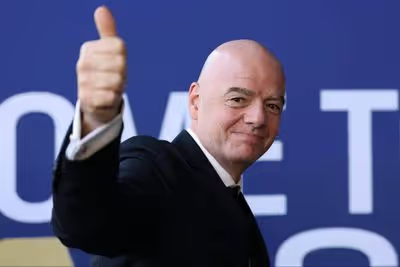
Gianni Infantino wants to carve FIFA’s commercial engine into a new company, FIFA Forward Enterprise (FFE), sell 20% to a Thrive Eternal–led investor group for $4.2bn and distribute a one-off plus boosted grants that would deliver up to $40m over four years to participating member associations. The rapid, opaque rollout and the involvement of Joshua Kushner’s Thrive have provoked immediate political and governance alarm across UEFA, Concacaf and other confederations.
What Infantino is proposing: FFE, a 20% sale and a cash sweetener
Gianni Infantino’s proposal creates FIFA Forward Enterprise (FFE) to consolidate FIFA’s commercial and event operations — media rights, sponsorships and ticketing for World Cups and other top competitions.FIFA would retain an 80% stake and control, while selling 20% to a geographically diversified investor group led by Thrive Eternal.
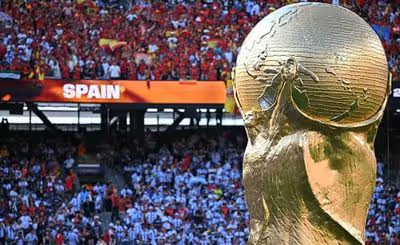
The headline sell-off value is $4.2bn, with the stated aim of using proceeds to launch a FIFA Fast-Forward Programme (FFFP) that dramatically increases grants to participating member associations.
Key mechanics and the member vote
Member associations have been asked to approve the plan by a specified deadline (the proposal cites September 19).If approved, federations that opt in would receive a one-off FFFP payment (announced as $20m) plus an uplift to the regular FIFA Forward Programme grants over the next four years (another $20m), totaling the $40m figure being promoted.Those who reject the deal would remain on the baseline FFP allocations, lower than the Infantino pitch.
Who is backing the buyer and why that matters
The proposed investor lead is Thrive Eternal, a vehicle set up by Thrive Capital founder Joshua Kushner.Thrive’s track record is heavy on tech and media investments and recent sport assets; Thrive Eternal has already moved into U.S. sports minority stakes.Why Thrive was selected and how the adviser shortlist (including JP Morgan and others) was compiled have not been fully explained in public disclosures — a major grievance among critics.
Why private capital would be interested
Private-equity and sovereign-wealth investors are attracted to predictable, large-scale broadcasting and sponsorship cash flows.Selling a minority stake in a tournament-driven revenue stream offers an upfront yield and long tail revenues — the same logic that brought private capital into Formula 1 and rugby.The commercial case is straightforward; the political and reputational implications are the hard part.
Joshua Kushner and reputational flashpoints
Joshua Kushner is the founder of Thrive Capital and the principal behind Thrive Eternal.While his firm has built a strong private-asset profile, his family links to U.S. political circles make this a high-profile partnership.Those reputational connections, fair or not, intensify scrutiny and feed the narrative critics are already using: a rushed, insider-driven commercialisation of the world game.
Financial math: how much, and for whom?
If investors pay $4.2bn for a 20% stake, that implies a valuation of about $21bn for FFE — and investors would take a cut of future tournament revenues.Using 2026-cycle revenue as a reference point, a minority stake could be worth billions in returns over several cycles.Infantino argues the lump sum funds will be transformational for developing federations; critics counter FIFA could redistribute reserves instead, avoiding the sale of long-term revenue rights.
What the money funds and the governance question
FIFA frames the plan as redistributive: more cash for development, infrastructure and grassroots projects in smaller federations.Those are real needs — training centres, coaching and youth programs — but governance critics warn that handing future commercial streams to private owners constrains FIFA’s long-term flexibility and risks prioritising revenue extraction over sporting integrity.
Political reaction: fast, fractious, strategic
The rollout has triggered swift statements from UEFA and expressions of concern across other confederations.UEFA’s pushback is predictable; the bigger story is the unease in Concacaf, Asia and among some African federations.Infantino understands the arithmetic of votes within FIFA’s 211-member structure and has long cultivated relationships with federations that depend on grant money — that political reality fuels his confidence.
Can Europe stop it?
Europe punches above its weight commercially, supplying the majority of elite players, clubs and revenue.Collective resistance from UEFA, European clubs, leagues and players’ unions could be decisive — particularly if backed by national governments or regulators such as the European Commission.However, unity is fragile: federations have different priorities and some European FA leaders have signalled openness to the cash on offer, complicating a unified blockade.
Governance and a potential motive: smoothing revenue and securing legacy
One plausible, defensible rationale for FFE is risk smoothing: World Cup cycles swing dramatically in value depending on hosts and formats, and a commercial arm focused exclusively on monetisation could stabilise funding flows.Those are intelligent strategic objectives on paper.But governance experts and critics also point to political incentives — creating a commercially run entity could offer future roles, compensation structures and influence that appeal to senior officials seeking long-term security after their presidential terms.
Transparency and process failings
Major complaints aren’t only about substance but process: the speed of the announcement, the perceived secrecy around adviser selection, and the late notice to key stakeholders undermined trust.That weakness has become the central lever for opponents: not necessarily arguing no to commercialisation, but demanding a slower, transparent, consultative approach with robust governance safeguards.
What could happen next
Expect an intense lobbying phase: federations will be courted, legal advisers will comb contract drafts, and confederations will weigh public statements versus private negotiations.UEFA could escalate with formal legal or regulatory pressure; national governments could intervene; clubs and players’ unions will leverage commercial and reputational arguments.Whatever the outcome, the process will reshape conversations about who controls football’s biggest rights and how the sport balances revenue needs with governance and independence.
Why it matters
This is more than a financial transaction.It's a governance crossroad that tests how football balances global equity, commercialisation and institutional checks on concentrated decision-making.For smaller federations the money is immediate and tangible; for clubs, leagues and fans the risk is long-term dilution of control over how the game’s most valuable assets are run.
Bottom line
Infantino’s FFE proposal poses a stark choice for FIFA’s membership: accept a rapid monetisation that guarantees short-term cash but hands a slice of future revenues to private capital, or insist on a slower, more transparent route that preserves full public control of competition revenues.
Inter Miami’s Messi and De Paul excused from MLS All-Star to prioritize post-World Cup recovery
Which path wins will be determined not by commercial logic alone but by politics, regulatory pressure and whether Europe’s powerbrokers can translate disquiet into decisive action.
 Theathleticuk