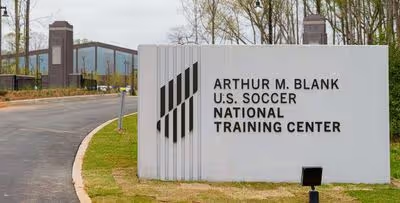
U.S. Soccer’s long-held ambition is now concrete: the Arthur M. Blank U.S. Soccer National Training Center opened in Fayette County, Ga., after a $50 million lead gift from Arthur Blank and roughly $250 million in total investment. The campus centralizes 27 national teams, a new headquarters and elite training facilities—aimed at professionalizing development, cutting long-term costs and giving the USMNT and USWNT a true home-field advantage on the world stage.
What opened and why it matters
U.S. Soccer has opened the Arthur M. Blank U.S. Soccer National Training Center in Fayette County, Georgia — a purpose-built campus intended to be the federation’s permanent home. The complex consolidates sporting operations, commercial functions and development programs for 27 national teams, from youth to disability squads. This isn’t just a facility: it’s a strategic pivot toward centralized development, more efficient operations, and a platform to compete in the World Cup with nations that long ago invested in single-site training ecosystems.
How the project came together
Cindy Parlow Cone’s push and the Blank meeting
The project accelerated after U.S. Soccer president Cindy Parlow Cone pressed for a unified HQ. A pivotal meeting with Arthur Blank in 2022 turned advocacy into momentum. Her candid pitch — delivered off-script and backed by a clear vision — helped secure Blank’s $50 million lead gift and his organization’s active involvement. Blank’s commitment unlocked a broader local fundraising push and corporate engagement that proved decisive.
From concept to commitment
The campus move grew out of decades of discussion. Previous efforts included joint ventures in Carson, Calif., and facilities co-located with MLS partners, but none provided federation ownership or singular control. The new NTC represents the first fully controlled, multi-use U.S. Soccer campus built with a long-term operational and sporting plan in mind.
Why Atlanta and Fayette County
Site selection prioritized weather, airport access, proximity to Europe for player travel, and a market able to attract talent and staff. Metro Atlanta met those requirements and offered a large contiguous land parcel. A major boost came when local philanthropists and businesses — aided by Arthur Blank’s network — stepped up with funding, a land gift from a regional benefactor, and municipal incentives that made the financial plan viable.
Funding, financing and delivery
The project assembled public and private capital: Blank’s lead gift, corporate partners, philanthropic land donation, and county-issued tax-exempt bonds (around $200 million) formed the backbone of the financing. Tax abatements and reduced utility commitments further lowered costs.
Despite skepticism about the timeline and scale, construction moved swiftly: heavy earthworks, extensive rock blasting and more than 7,000 truckloads of material transformed pasture and woods into playing surfaces and buildings. The build involved roughly 1,600–1,700 contributors, peaking at 500 workers on site.
Facilities and programming
The campus houses a multi-story headquarters, more than a dozen pitches, a “superpitch” designed for senior national teams, dedicated youth fields, a full gym and court, multiple locker rooms, hospitality spaces and workspaces for several hundred staff.
Design intentionally tiers fields: youth and community arenas sit lower on the site while the marquee pitch occupies higher ground, signaling a pathway from aspiring player to national-team stage. The program plan includes training camps, youth tournaments, coaching education and commercial activations.
Reaction from the soccer community
Emotional responses have been immediate: disability teams, beach and power-soccer groups reacted viscerally to seeing bespoke spaces for the first time, and former players described the complex as a long-overdue home. Leadership voices framed the NTC as an infrastructure shift: it’s a facility that reduces ad hoc camp costs, consolidates staff interaction with sport operations and offers a base for sustained player development.
Analysis: what this means and what’s at stake
Centralizing operations is a practical and cultural inflection point. On the practical side, owning a home reduces repeated venue rentals, streamlines logistics for camps and creates new revenue and branding opportunities. Culturally, a permanent campus can align business, coaching, medical and youth-development functions around a single identity. That upside, however, hinges on execution.
The campus must be more than impressive architecture; it must host consistent programming, balance elite access with community engagement, and turn capital investment into measurable development outcomes. If U.S. Soccer delivers robust year-round use and leverages commercial assets intelligently, the NTC could accelerate player pathways and program cohesion. If utilization lags, maintenance and operating costs will quickly become a governance test.
Next steps and metrics to watch
Immediate priorities are operationalizing the campus: scheduling national-team camps, launching coaching and grassroots programs, and opening commercial partnerships that were promised in the fundraising phase. The pre-World Cup timelines and high-profile camps will be early tests of the site’s efficacy.
Key metrics to watch: facility utilization rates, cost savings versus previous operations, revenue from naming and partnerships, and early indicators of player development gains (training load, scout access, integration across age groups). Long-term success will be judged by how the NTC improves competitive results and deepens the sport’s domestic infrastructure.
Bottom line
The Arthur M. Blank U.S. Soccer National Training Center is a landmark investment that transforms a perennial aspiration into tangible assets. It’s a strategic, expensive bet on centralized development that gives the USMNT, USWNT and other national programs a coherent home.
New Jersey chosen as World Cup base by Brazil, Morocco, Haiti, Senegal
The facility sets the stage; now U.S. Soccer must prove it can turn infrastructure into sustained competitive and developmental returns.
 Theathleticuk