France and England meet in the 2026 World Cup third-place playoff at Hard Rock Stadium, Miami, on July 18 — a high-stakes consolation that still carries ranking points, prize money and Golden Boot implications for Kylian Mbappé and Harry Kane. For both nations, the match is a brief, vital chance to salvage pride, influence FIFA rankings and shape momentum ahead of the final weekend.
Third-place playoff: France vs England — what’s on the line?
France and England face off for third place at the 2026 World Cup in Miami, a match that looks like consolation on paper but matters in practice.Beyond bronze medals, the game affects FIFA rankings, hands out extra prize money and offers a final chance for goal-scorers such as Kylian Mbappé and Harry Kane to boost Golden Boot tallies.
The fixture also fills the slot between the semis and final, giving both nations one last high-profile stage to measure squad depth and resilience.
Why FIFA keeps the ‘bronze final’
The third-place playoff has been a World Cup fixture since 1934 (with a few exceptions) because it serves multiple logistical and commercial purposes.Broadcasters gain an extra marquee game, host cities sell more tickets, and FIFA preserves a clear tournament hierarchy through official placings.The match also carries greater competitive weight than a friendly: FIFA ranking points are awarded and can influence future Nations League seedings and qualifying draws.
Prize money and recognition
Winning the playoff brings bronze medals and additional prize money — the third-place side receives a larger payout than the fourth-placed team.The winner secures financial and symbolic reward rather than a trophy, which keeps the match tangible for federations even when players are emotionally drained from a semi-final exit.
History and landmark moments
The playoff was first staged in 1934 and, apart from format-based interruptions, has been a regular feature ever since.It has produced memorable records and moments that have shaped World Cup lore.
Notable records set in third-place matches
- 1958: Just Fontaine scored four goals in France’s 6-3 win, cementing his record of 13 goals in a single World Cup. - 2002: Hakan Şükür scored for Turkey after 11 seconds — the fastest goal in World Cup history — in the third-place match against South Korea. - 1998–2010: Several Golden Boot winners (Eusébio, Salvatore Schillaci, Davor Šuker, Thomas Müller) used the playoff to extend their tallies.
Memorable podium finishes
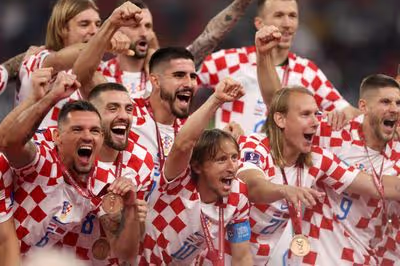
Third-place results have offered career-defining moments for emerging nations: Croatia’s 1998 bronze remains a foundational national memory, and Sweden’s 1994 4-0 win provided a fairytale end on U.S. soil.Equally, giants like Germany have used the playoff to steady narratives after disappointments, collecting multiple bronze medals across tournaments.
How managers and teams treat the fixture
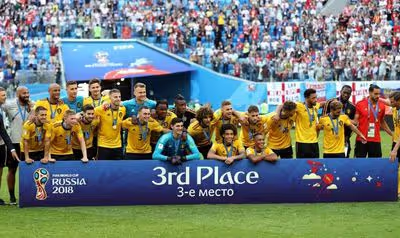
Attitudes towards the playoff are mixed. Some managers publicly deride it — Louis van Gaal called the match “unfair” after 2014 — while others frame it as an opportunity.Rotations are common: captains and established starters are sometimes rested, giving fringe players competitive minutes and managers a chance to reward squad contributors.England’s 2018 defeat to Belgium, and subsequent comments from media figures, underlined the game’s emotional awkwardness for teams that pushed deep in the tournament.
When teams take pride
For nations that overachieve, the playoff is celebrated rather than dismissed.Croatia in 1998 and Sweden in 1994 used third place to convert tournament momentum into national pride, creating lasting positive narratives despite missing the final.
What to watch in the Miami showdown
Starting lineups and rotation will reveal each coach’s priorities: do France and England field full-strength XIs, or rest key figures after brutal semi-finals? Kylian Mbappé and Harry Kane’s goal counts will be focal points for neutrals tracking the Golden Boot race.Federation strategists will also watch FIFA ranking outcomes — a win could nudge seeding and fixtures in future competitions.
Why the match still matters
On the surface the bronze final is a consolation; beneath it are concrete incentives: ranking points, prize money, individual records and the psychological lift of ending a tournament on a win.Rarely do both teams arrive with nothing to play for — and when they do commit, the third-place playoff frequently delivers entertainment and narrative closure for a World Cup campaign.
Possible implications after the whistle
A victory will offer momentum and a clearer assessment of squad depth for both federations.A loss, by contrast, can amplify disappointment but also clarify areas that need rebuilding before the next international cycle.
Messi inspires stoppage-time heroics as Argentina overturn England to reach World Cup final
Either way, the Miami match will matter more than many expect.
 Theathleticuk