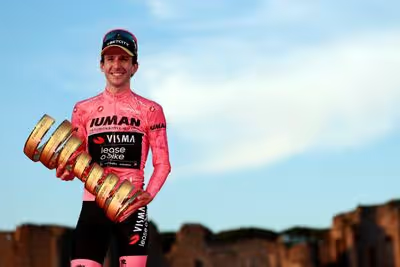
Giro d'Italia 2026 opens Friday 8 May with a historic Grande Partenza in Bulgaria and Simon Yates’ surprise retirement leaving the maglia rosa up for grabs. Jonas Vingegaard arrives as the hot favourite to complete a rare Grand Tour set, but seven summit finishes, a single 42km individual time trial and a brutal Dolomites queen stage (including the Cima Coppi) mean the final week should still decide the winner.
Giro d'Italia 2026: key facts and context
The 109th Giro covers 3,459km with 49,150m of climbing, starting in Bulgaria and finishing in Rome on 31 May. Organisers have built a route that balances sprinters, breakaway specialists and pure climbers: eight flat stages, seven summit finishes, seven medium-mountain days and one solitary 42km individual time trial in Viareggio. The best of cycling.
This is a consequential edition. Simon Yates’ late retirement removes the defending champion and reshuffles pre-race dynamics, handing the initiative to established Grand Tour talent and ambitious challengers alike.
Big picture: what the route demands
Only one long time trial means climbers still hold the strategic edge, but that lone TT is long enough to punish those who arrive undercooked. The first true GC test lands early on the brutal Blockhaus (stage 7), while the race’s fate is most likely sealed across stages 19–20: a Dolomites queen stage with the Cima Coppi (Passo Giau) and a second summit finish the following day at Piancavallo.
Riding through Switzerland on stage 16 adds an unpredictable punch: a short but savage 113km day with 3,000m of climbing can crack tired legs after the rest day. In short, this Giro asks for consistent toughness across three intense weeks rather than a single standout performance.
Top contenders and teams to watch
Jonas Vingegaard (Visma-Lease a Bike) is the clear pre-race favourite — the rider with the strongest pedigree for controlling a three-week fight. He arrives as the rider most likely to take advantage of a modest TT loss and then flex in the high mountains.
Primary challengers include:
Jai Hindley (Red Bull - Bora - hansgrohe): proven Grand Tour climber and capable stage hunter.
Enric Mas (Movistar): consistent podium-level GC talent with a well-rounded team.
Adam Yates (UAE Team Emirates-XRG): a dangerous opportunist who can attack on punchy climbs and in short, intense stages. Other names to monitor for stage glory or surprise GC moves: Einer Rubio (Movistar), Will Barta (Tudor), and late-stage breakers such as Damiano Caruso and Gijs Leemreize.
Sprinters and fast men expected to animate flat finishes: Kaden Groves (Alpecin-Premier Tech), Jonathan Milan (Lidl-Trek), Dylan Groenewegen (Unibet Rose Rockets) and Tim Torn Teutenberg.
Stage-by-stage: the moments that will shape the GC
Opening weekend and the Bulgarian Grande Partenza (stages 1–3)
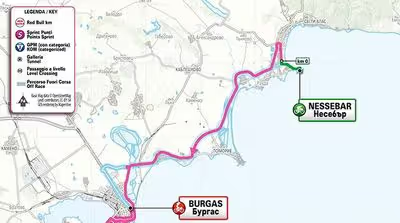
Fast coastal stages in Nessebar, Burgas and Plovdiv favour sprinters, but stage 2’s late climb to Veliko Tarnovo offers an early seam for bonus seconds and an opportunistic attack. The first rest day allows organisers to transfer the race into Italy — a logistical wrinkle riders must manage.
Stage 7 — Blockhaus: first serious GC filter
A 244km Apennine monster with nearly 4,600m of climbing and a summit finish on Blockhaus. This is the race’s first real GC litmus test: sustained gradients up to 14% will expose who’s carrying form and who’s bluffing.
Stage 10 — Viareggio to Massa, 42km ITT
One long, flat TT that could swing minutes. Time trialists will aim to distance pure climbers here; the latter must limit losses and trust the mountains ahead. Team tactics and position on the road will be critical.
Stage 14 and the Val d’Aosta assault
A short but savage mountain day to Pila delivers continuous grinding climbs and double-digit pitches. Expect attrition and possibly a shake-up inches from the top riders’ comfort zones.
Stage 19 — the queen in the Dolomites
This is the defining day: six classified climbs, the Passo Giau as Cima Coppi and a relentless sequence that offers no respite. With 5,000m of climbing in the final 100km, expect the big move for the maglia rosa here, or at least the decisive time gaps.
Stage 20 — Piancavallo finale
After yesterday’s Dolomite carnage, Piancavallo’s repeated ascent and a steep final kilometre are tailor-made for one last GC assault or a dramatic late reshuffle.
What this Giro means — analysis and implications
With Yates out, the race becomes a question of depth versus dominance. If Vingegaard’s team can control the mountains and cover early moves, he has the profile to claim the only Grand Tour jersey he hasn’t yet worn. But RCS has engineered a course that discourages monotony: the combination of a single long TT, plenty of summit finishes and hectic transitional stages rewards teams who can both defend and attack across varied terrain.
Teams without a clear GC leader can still shape the race. Breakaway specialists and punchy riders will target the medium-mountain days and late-stage climbs; those victories can tilt morale and, occasionally, the GC.
What to watch day-to-day
- Who survives Blockhaus without losing time? That will indicate true contenders.
- How much damage do pure climbers accept in the Viareggio ITT? Time deficits there will force strategies in the Dolomites.
- Will stage 19 produce an outright winner or leave a one-day gap for the final summit test at Piancavallo?
- Which sprint teams control the flat phases, and who can still survive the punchy finishes?
Bottom line
This Giro is balanced to both produce bold stage winners and deliver a late, decisive GC fight. Expect the race to come alive in the final week, but don’t discount early drama: Blockhaus and the Viareggio time trial will already reveal who has legitimate ambitions.
Jonas Vingegaard will make his Giro d’Italia debut this year
For riders and teams, the mission is clear — be aggressive when needed, conservative when necessary, and save something for the Dolomites.
 The Independent