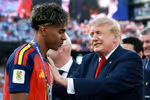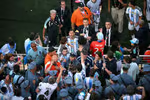
Footage of Lionel Messi’s tense pre-match tunnel words has amplified questions about Argentina’s mental state after their World Cup final defeat to Spain, as an injury to Lisandro Martínez, Enzo Fernández’s red card and post-match altercations compounded a performance that only produced a first shot deep into extra time. Claims of pre-game anti-doping tests contradict standard procedure, but the images underline a side visibly short of composure at football’s biggest moment.
Messi tunnel footage fuels debate after World Cup final loss to Spain
Lionel Messi’s brief, urgent words in the tunnel captured a moment of raw emotion that many interpreted as evidence Argentina were unsettled before kick-off.
The team struggled to impose themselves in the MetLife Stadium final, registering virtually no attacking momentum until the second half of extra time.
Key match incidents: injury, red card and a quiet attack
Lisandro Martínez exited early with an injury that weakened Argentina’s defensive balance. Enzo Fernández was sent off in the closing stages of normal time, leaving his side numerically compromised. The combination of those blows and Spain’s control left Argentina with hardly any clear chances until extra time.
What the tunnel footage shows
Messi is heard urging teammates to reset: "Come on, boys, let's forget what happened, as if nothing had happened." Later he told the players: "Personality, people, personality. We've always had it, so why wouldn't we have it now?" Goalkeeper Emiliano Martínez added: "With heart, lads. Let's move forward, not backward... Only cowards play backward." Those snippets reveal leadership trying to steady a group that, on camera, looked emotionally frayed.
Anti-doping test claims and the facts
Social-media chatter alleged unannounced anti-doping controls immediately before the final, offered as an explanation for visible agitation. Anti-doping protocols are typically conducted post-match, and the timing claim runs counter to standard practice. That distinction matters: factual clarity removes one convenient excuse and returns focus to injury, discipline and preparation as primary factors.
Discipline and conduct: post-match altercations deepen scrutiny
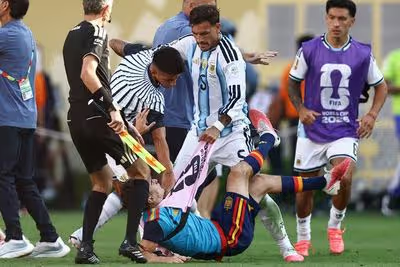
The final did not end without incident. Leandro Paredes was involved in a confrontation with Gavi and Eric García, while Nahuel Molina and an assistant coach were seen in physical exchanges. Those scenes add a layer of reputational damage and will invite disciplinary review from governing bodies.
Why this matters for Scaloni and the squad
For Lionel Scaloni, the sequence — tense tunnel footage, an early injury, a late red card and unsavoury post-match conduct — composes a broader problem set beyond a single defeat. Finals are won or lost on margins; visible emotional distress and disciplinary lapses are avoidable margins that can be addressed through clearer routines, stronger situational management and a focus on accountability.
What comes next for Argentina
Short term, attention will turn to possible suspensions, medical recoveries and internal debriefs. Longer term, the squad must reconcile the pride of reaching consecutive finals with the need to rebuild discipline and tactical cohesion. The footage is a reminder that elite teams must manage both the physical and psychological preparations for decisive matches.
Takeaway
The tunnel clip did not create Argentina’s problems, but it crystallised them on camera: a team undermined by injury, a costly red card and moments of indiscipline.
Clearing up misinformation about anti-doping timing is useful, yet the more pressing lessons are internal — how to preserve composure, enforce discipline and convert elite talent into the consistency required to win finals.
 Mirror