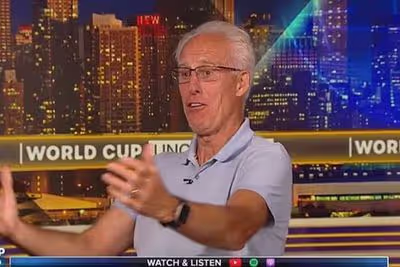
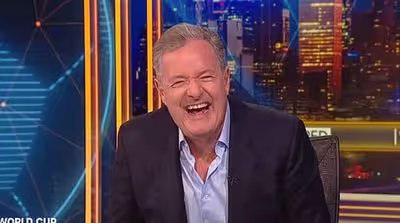
Piers Morgan and Mick McCarthy reignited a 17-year feud on Sports Uncensored after McCarthy defended his controversial decision to rotate a near-full Wolves squad for a 2009 trip to Old Trafford, prompting sharp exchanges over managerial duty, fan expectations and the unintended consequences for Arsenal’s title bid that season.
Morgan and McCarthy clash over 2009 Wolves rotation — old grievance flames up
Piers Morgan and Mick McCarthy returned to a long-running row on live TV when McCarthy revisited his rationale for resting 10 outfield players for Wolves’ midweek trip to Manchester United in December 2009. The decision, which led to a 3-0 defeat, has been blamed by many Arsenal supporters — Morgan among them — for affecting that season’s title race between Arsenal and United.
The 2009 fixture and immediate fallout
Wolves, promoted the previous season, had beaten Tottenham 1-0 on the Saturday before facing United. McCarthy elected to rotate heavily for the fast turnaround, fielding a weakened side at Old Trafford. United won comfortably and Arsenal were held by Burnley days later, a sequence that fuelled accusations the Wolves manager had effectively handed three points to Sir Alex Ferguson’s side.
What was said on Sports Uncensored
On Morgan’s programme the argument resurfaced with blunt exchanges. McCarthy defended his choice emphatically, arguing his priority was keeping Wolves in the Premier League — a goal he ultimately achieved, finishing eight points clear of relegation and securing long-term financial benefits for the club. Morgan countered that managers owe a duty to fans and that such rotation had tangible consequences for rival clubs’ title hopes. The conversation turned personal, with expletive-laden barbs traded before both men acknowledged a degree of hypocrisy.
Why the dispute still matters
This isn’t just nostalgia. The clash crystallises a perennial tension in modern football: pragmatic squad management versus the expectations of supporters and the perceived integrity of competition. McCarthy’s rotation was defensible from a sports-science and fixture-management standpoint, yet critics argue it ignored the broader impact on rivals and spectators. The episode is an early, raw example of dilemmas that now dominate conversations around cup prioritisation, congested schedules and squad depth.
McCarthy’s justification holds up on results
Managerially, McCarthy achieved his objective. Wolves survived that season and the club reaped sustained top-flight revenue. From a purely internal performance metric — preserving the squad, targeting points across a season and ensuring survival — the rotation was vindicated. That pragmatic lens is often absent from the more emotive fan perspective, which measures decisions by how they affect title races and marquee fixtures.
Morgan’s grievance is understandable, but selective
As an Arsenal fan, Morgan’s frustration is credible: key results against rivals shape title races. Yet the expectation that every manager must prioritise the entertainment value of a single fixture — potentially at the expense of his own club’s long-term health — is arguably unfair. The spat highlights how media personalities amplify fan sentiment and can keep decade-old controversies alive in the public imagination.
Broader implications for Premier League management culture
The episode foreshadowed modern debates over rotation, fixture congestion and the ethics of selection. Today’s managers have larger squads and more sophisticated rotation strategies, but the core conflict remains: balance immediate spectacle against season-long objectives. McCarthy’s blunt defence reminds observers that managers are judged primarily on club survival and results, not on preserving the competitive fortunes of rivals.
What this means going forward
The Morgan–McCarthy exchange is unlikely to change minds, but it’s a useful case study. Fans and pundits should recognise the competing responsibilities managers face; media figures, meanwhile, will continue to press narratives that represent club and viewer interests.
The lasting takeaway is that high-stakes football produces clashes of legitimacy — between tactical necessity and the emotional stakes of supporters — and those clashes will keep resurfacing as long as the sport rewards both short-term spectacle and long-term stability.
 Mirror