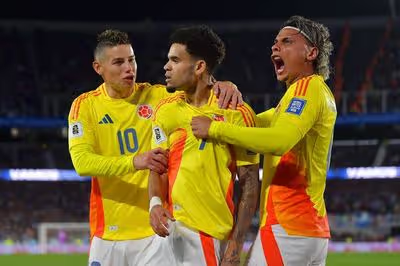
Colombia head into World Cup 2026 at a fraught crossroads: Copa America pain exposed tactical and personnel cracks under a manager whose authority is questioned, while an ageing James Rodriguez struggles to justify his place. Luis Díaz’s form offers a genuine route to optimism, but internal chaos and conservative leadership could squander a rare shot at deep knockout progress in North America.
Colombia's precarious position ahead of World Cup 2026
Colombia arrives in North America with talent to unsettle anyone but with clear structural problems. The run to the 2024 Copa America final ended in defeat to Argentina and, by many accounts within the camp, left a camp that feels fragile. Squad prestige — from historical flair to a modern crop of elite attackers — collides with questions over leadership, form and tactical clarity.

James Rodriguez: a fading icon and a selection dilemma
From 2014 heroics to present-day concerns
James Rodriguez remains Colombia’s most glittering recent international star, the midfielder who lit up the 2014 World Cup and delivered moments of genuine genius. That legacy, though, is now under strain. His club career outside Europe’s elite has dented rhythm and sharpness, and his current performances have prompted blunt conversations about whether sentiment is outweighing the team’s needs.
What his decline means for Colombia
Keeping James in the XI carries tactical and psychological consequences. He still draws attention and can unlock matches, but when that influence is diminished he becomes a liability — a selection based on reputation rather than match-day impact. The real test for the coaching staff is whether they can prioritise collective balance over nostalgia.
Luis Díaz: the emergent talisman Colombia can rely on
Consistency, output and leadership
Luis Díaz has stepped into the void with the kind of consistent attacking output Colombia has long craved. His pace, directness and finishing give the side a genuine matchwinner on the wing. When Díaz is firing, Colombia suddenly becomes a team capable of breaking down premium defences; he transforms tactical options and raises realistic expectations for a deep run.
How Díaz shifts Colombia’s identity
Díaz’s form allows Colombia to be less predictably decorative and more ruthlessly effective. He forces opponents to respect transition speed, which can open space for midfield creators — but only if the manager builds a cohesive plan that protects defensive frailties and balances risk.
Tactical and managerial questions that will define the campaign
Predictability vs bravery
Colombia’s perennial issue remains predictability: talented individuals produce flashes, but the team often lacks a coherent system for 90 minutes. The manager’s role is decisive. Tactical courage — dropping underperforming veterans, varying pressing intensity, and committing to game plans that suit the opposition — will determine whether Colombia can translate individual quality into tournament progression.
Squad composition and defensive stability
Offensive talent is plentiful, but defensive organisation and midfield control are less assured. A tilt toward conservatism to protect fragile structures risks nullifying attacking strengths. Conversely, blind faith in flair without a pragmatic framework invites collapse against well-drilled opponents.
North American factor: near-home advantage and pressure
A partisan atmosphere
With large Colombian communities across the United States and Mexico, the tournament will often feel like home. That proximity is an asset — intense crowd support can lift performance levels and unsettle rivals. It also raises expectations; when the stands are yellow and loud, the margin for error shrinks.
Rivalries and regional context
Historical rivalries influence fan sentiment and narrative pressure. Matches against regional favourites will carry extra weight for supporters and players alike, amplifying both opportunity and scrutiny.
Group stage and realistic benchmarks
Colombia’s draw in Group K alongside Portugal, Uzbekistan and the Democratic Republic of the Congo is manageable on paper but not without pitfalls. Progress beyond the group should be the minimum objective; advancing deeper will require tactical adaptability and consistent form from key players.
What this tournament could mean for Colombian football
Colombia can use this World Cup as a reset: proving whether its abundant talent can be harnessed by modern coaching or whether structural and leadership issues will persist. A quarter-final run would represent consolidation and a step forward. Failure to advance would expose deeper systemic problems and potentially trigger changes in personnel and strategy.
Bottom line
Talent is indisputable; coherence is not. Colombia’s fate in World Cup 2026 hinges less on flashes of individual brilliance and more on managerial backbone and collective discipline. If the coach shows the necessary courage and Díaz stays imperious, Colombia can upset expectations.
Casemiro 'could stay at Man Utd next season' as team-mate drops hint - 'You never know'
If sentiment overrides selection and structure, the tournament risks confirming the worst warnings about internal chaos.
 Mirror