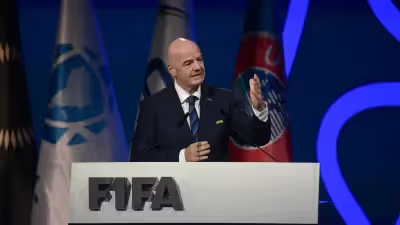
FIFA has proposed selling a roughly 20% minority stake in the World Cup through a new commercial vehicle — FIFA Forward Enterprise — promising an upfront $20m to each member association plus another $20m per federation later. The plan has provoked fierce opposition from UEFA and other critics who say it risks commodifying the sport and concentrating power, while federations must respond by Sept. 19 ahead of a divisive FIFA Congress vote.
What FIFA is proposing: the FIFA Forward Enterprise explained
FIFA plans to form a controlled commercial subsidiary, FIFA Forward Enterprise (FFE), to consolidate its commercial and event operations and sell a significant minority stake to outside investors. The proposed stake is roughly 20% of the enterprise, which FIFA values at about $20 billion.
FIFA says proceeds would fund member associations worldwide and accelerate development projects across federations that lack commercial heft.
Immediate cash and the headline numbers
FIFA is offering each of its 211 member associations an immediate $20 million payment if they back the proposal by the Sept. 19 deadline, plus a further $20 million during the next World Cup cycle.
That promised $40 million-per-federation headline is designed to be an immediate political lever to secure buy-in from smaller, cash-strapped associations.
Who the investors might be
The discussions around FFE name large financial and private investors as potential partners, with the deal structured to give outside capital direct access to World Cup revenues without transferring full control.
Selling a minority stake rather than the tournament outright is FIFA's attempt to balance revenue generation with institutional control.
Immediate backlash: UEFA, national federations and political pushback
UEFA has been the most vehement critic, accusing FIFA leadership of plotting to enrich insiders and warning the move risks selling the sport’s core assets.
Several national associations and political figures have also expressed alarm, framing the World Cup as a global public good rather than a tradable commodity.
Some federations, however, have publicly signalled support for the offer, illustrating a deep split between cash-needy associations and those worried about governance implications.
Confederation responses matter
Responses from confederations such as CONCACAF have been more measured, expressing disappointment at the process but stopping short of full-throated rejection.
That mixed reaction sets up a fragmented vote dynamic at FIFA Congress and complicates any unified opposition strategy.
Why this matters: governance, commercialisation and competitive balance
This proposal is more than a commercial transaction — it strikes at governance norms in global football.
A minority sale linked to guaranteed federation payouts could reshape incentives inside FIFA, weakening checks on executive power and centralising influence around investors and top officials.
For smaller federations, the cash offer is transformative; for larger federations and confederations, the risk is long-term erosion of institutional control and greater commercialisation of competitions.
Sporting consequences
If FFE steers commercial decisions, tournament scheduling, trophy rights or broadcasting priorities could increasingly reflect investor returns, not sporting integrity.
That creates a tension between short-term development funding and preserving the competitive and cultural value of the World Cup.
What happens next: the Sept. 19 deadline and the Congress vote
FIFA has given member associations a firm deadline to signal support in order to access the initial $20 million payout.
A vote at FIFA Congress will ultimately determine the plan’s fate, but the required threshold — a simple majority or a heightened supermajority tied to statute changes — is disputed and could be decisive.
Scenarios to watch
If a large bloc of smaller federations accepts the upfront cash, the plan could pass even against the objections of powerful confederations.
Conversely, co-ordinated opposition from UEFA plus influential members could force statutory hurdles or a reworking of the proposal.
Analysis: why the timing and framing are political
Presenting the deal as immediate development cash makes it politically potent: federations with stretched budgets face a stark choice between short-term funding and long-term governance risk.
The tight deadline compresses debate and advantages FIFA’s executive narrative. That tactical urgency raises legitimate questions about due process inside the organisation.
Bottom line — the sport at a crossroads
FIFA Forward Enterprise is a high-stakes gamble that could deliver rapid capital to global football while simultaneously redrawing where power and money sit in the game. The coming weeks will reveal whether federations prioritise immediate resources or push back to defend institutional safeguards.
Pochettino Extension Boosts Stability: Where USMNT Now Ranks in 2030 World Cup Betting
Either outcome will reverberate across football’s governance landscape for years.
 Sporting News