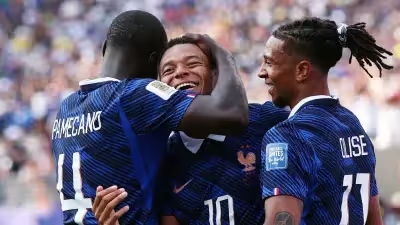
France’s World Cup roster has drawn heat over “foreign-born” players, but Les Bleus actually include only three players born outside France — Michael Olise, Marcus Thuram and Brice Samba — while France remains the single biggest country of birth for World Cup players (99). The debate reveals more about modern eligibility rules and the strength of France’s domestic system and diaspora than it does about selection impropriety.
Les Bleus largely France-born despite public outcry
France’s 2026 World Cup squad is mostly home-grown: 23 of 26 players were born in France, with only three squad members born abroad. That simple tally cuts through the noise. The criticism that the roster is “filled” with foreign-born players misreads how international eligibility and modern football migration actually work.
Who the three foreign-born players are — and why it matters
Michael Olise — London-born creative force
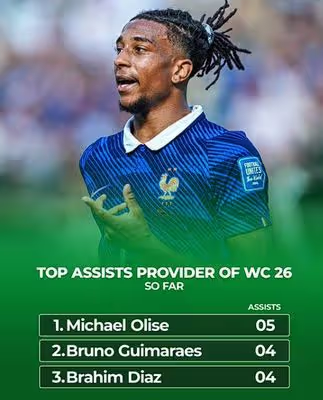
Michael Olise, born in London, has been the tournament’s creative engine for France. Now at Bayern Munich, the 24-year-old supplied multiple assists and has become a go-to playmaker for Les Bleus. Olise’s choice to represent France reflects upbringing, footballing influences and clear sporting pathways rather than simplistic national labels.
Marcus Thuram — Italian-born forward with French roots
Marcus Thuram, born in Parma while his father played in Italy, brings physicality and experience to France’s forward corps. A dual-national upbringing and family ties to French football explain his commitment to Les Bleus, underscoring how family lineage and competitive ambition intersect in player choices.
Brice Samba — goalkeeper who migrated young
Brice Samba, born in the Republic of the Congo and raised in France from a young age, provides veteran depth in goal. His inclusion is a reminder that birthplace alone rarely captures a player’s footballing identity when formative years and development occur elsewhere.
France’s tournament-wide impact on player birth statistics
France supplies more World Cup players born within its territory than any other nation in the 2026 field, with 99 players born there across 13 different national teams. Other leading countries by number of players born there include:
- Netherlands — 67 players born there
- Germany — 50 - England — 47
- Sweden, Spain, Belgium — 36 each
- Austria — 31
- Switzerland, Argentina — 30 each
These figures highlight France’s unusually deep pipeline of talent both for its national team and for other countries whose squads include France-born players.
How international eligibility actually works
Players can represent a country if they meet one of several straightforward criteria: - They were born in the country or territory - A biological parent was born there - A grandparent was born there - They have completed a requisite period of residency
Those rules explain why a player born in one nation may legitimately choose another — nationality decisions are often personal, practical and shaped by career considerations.
Why the controversy misses the bigger story
The fuss over “foreign-born” players distorts two realities. First, birthplace isn’t destiny — development pathways, family ties and early life experiences typically shape a player’s national identity more than the location of their birth. Second, France’s youth systems and scouting network are exceptionally productive; the country’s depth exports talent globally and fuels stronger national squads, domestic leagues and rival national teams that benefit from France-born players.
Public ire often frames the issue as betrayal, but the data suggest a different headline: France’s football ecosystem is both broad and porous, producing elite players who make legitimate, varied choices about international representation.
What this means going forward
For coaches and federations, the takeaway is pragmatic: talent acquisition and retention depend on relationships, clear pathways, and competitive opportunity. For fans and commentators, the challenge is to move beyond simplistic birthplace narratives and evaluate selections on merit, fit and the developmental realities of modern football.
Bottom line
Les Bleus’ roster is overwhelmingly France-born; the handful of exceptions illuminate the modern, multinational nature of football rather than undermine the team’s national character.
Pochettino extension to 2030 signals US Soccer's shift to long-term program building
The debate should shift from birth certificates to the substantive questions: who develops talent, who offers opportunity, and which systems produce consistent elite performers.
 Sporting News
.jpg-1783963266.webp?w=150&q=70&fit=cover)