Colombia arrive at the 2026 World Cup as genuine dark horses under Néstor Lorenzo, led by Bayern's Luis Díaz and veteran James Rodríguez. A seasoned 26-man roster offers balance, but fitness doubts and a tricky Group K with Portugal, DR Congo and Uzbekistan make the opening fixtures immediately decisive for Lorenzo’s tactical plan and Colombia’s chances of progressing deep.
Colombia World Cup outlook: experience meets early tests in Group K
Colombia head to the 2026 World Cup with momentum and expectation. Néstor Lorenzo has assembled a veteran-heavy squad that blends proven international performers with a few exciting young additions. That mix makes Colombia dangerous in transition and set pieces, but their path is sharp-edged: Group K throws up Portugal and two unpredictable opponents in DR Congo and Uzbekistan.

How Lorenzo navigates the opening matches will largely determine whether Colombia reach the knockout phase.
Full Colombia World Cup roster
Goalkeepers
David Ospina — Atletico Nacional — 37 — 129 caps
Camilo Vargas — Atlas (Liga MX) — 37 — 40 caps
Alvaro Montero — Millonarios / on loan at Vélez Sarsfield — 31 — 11 caps
Defenders
Davinson Sánchez — Galatasaray — 29 — 77 caps
Yerry Mina — Cagliari — 31 — 52 caps
Daniel Muñoz — Crystal Palace — 29 — 44 caps
Santiago Arias — Independiente — 34 — 63 caps
Jhon Lucumí — Bologna — 27 — 35 caps
Johan Mojica — Mallorca — 33 — 43 caps
Deiver Machado — Nantes — 32 — 14 caps
Willer Ditta — Cruz Azul — 29 — 3 caps
Midfielders
James Rodríguez — Minnesota United — 34 — 124 caps
Jefferson Lerma — Crystal Palace — 31 — 64 caps
Jhon Arias — Palmeiras — 28 — 36 caps
Richard Ríos — Benfica — 25 — 30 caps
Juan Fernando Quintero — River Plate — 33 — 47 caps
Kevin Castaño — River Plate — 25 — 24 caps
Jorge Carrascal — Flamengo — 28 — 22 caps
Jaminton Campaz — Rosario Central — 26 — 9 caps
Juan Camilo Portilla — Athletico Paranaense — 27 — 8 caps
Gustavo Puerta — Racing Santander — 22 — 4 caps
Forwards
Luis Díaz — Bayern Munich — 29 — 72 caps
Jhon Córdoba — Krasnodar — 33 — 21 caps
Luis Javier Suárez — Sporting CP — 28 — 10 caps
Cucho Hernández — Real Betis — 27 — 7 caps
Carlos Andrés Gómez — Vasco da Gama — 23 — 8 caps
Immediate concerns: fitness and form
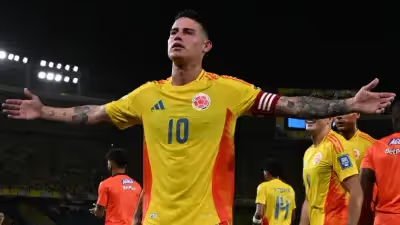
James Rodríguez’s recent hospitalisation for severe dehydration earlier in the year remains the headline fitness concern, though he returned to club action in May and produced two assists in one match. That recovery matters: James still dictates tempo and creates chances when he’s right, and Colombia’s midfield control improves markedly with him on the pitch. Beyond James, several starters are veteran players whose minutes and conditioning across a long season will require careful management from Lorenzo.
Players to watch and tactical implications
Luis Díaz is Colombia’s clearest match-winner. His speed, movement and link-up with midfielders make him the chief creative outlet and the player likely to decide tight games. James Rodríguez provides the vision and set-piece threat; pairing those two gives Colombia a genuine attacking spine.
Defensively, Davinson Sánchez and Yerry Mina offer aerial threat and experience but have periods of inconsistency that could be exposed by high-quality European attackers like Portugal’s. Gustavo Puerta is the tournament’s intriguing wildcard — a young midfielder who adds energy and verticality and could be Lorenzo’s plan B in congested fixtures.
Néstor Lorenzo: rise, reputation and pressure
Lorenzo has transformed Colombia since taking over in 2022, steering a 28-match unbeaten run and beating major opponents in qualification. His commitment to an attractive, proactive style has raised expectations. That progress now brings a different pressure: results at the finals. Lorenzo’s tactical choices — whether to prioritise control through James and Lerma or to play more direct through Díaz and the forwards — will tell us if Colombia can translate qualifying scalps into tournament consistency.
Group K: schedule and immediate stakes
Colombia were drawn in Group K alongside Portugal, DR Congo and Uzbekistan. The opening fixtures are crucial given the competitive balance.
Wed, Jun. 17 — Uzbekistan vs Colombia — Estadio Azteca, Mexico City
Tues, Jun. 23 — Colombia vs DR Congo — NRG Stadium, Houston
Sat, Jun. 27 — Colombia vs Portugal — Hard Rock Stadium, Miami
A solid result in Mexico City would settle nerves and allow Lorenzo to manage rotations. Facing Portugal in the final group match is likely to be decisive; by then, squad fitness and points tally will define tactics — whether to pursue control or counter-attack.
What this means and what to expect next
Colombia have the personnel and tactical identity to be one of the tournament’s pleasant surprises. Strengths are clear: a cohesive backline with set-piece potency, elite wide play from Luis Díaz, and creative output from James.
Risks are also evident: ageing figures across key positions, minutes-related fatigue, and a back line that can be inconsistent under pressure. If Lorenzo gets player management right and the midfield balance clicks, Colombia can reach the knockout rounds. If injuries or fatigue bite, Group K contains enough quality to punish errors quickly.
Historical context
This will be Colombia’s seventh World Cup appearance and their third since 1998. Their best run remains the 2014 quarterfinals in Brazil.
The squad’s experience and recent results in CONMEBOL qualifying signal that they should not be underestimated — but finals are a different measurement of consistency and depth.
 Sporting News