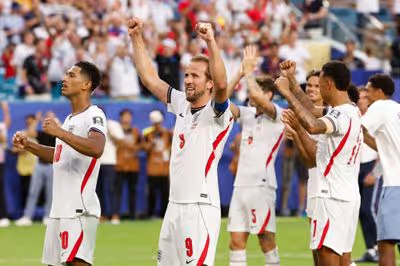
England head into a World Cup semi-final against Argentina in Atlanta buoyed by a rare Chinese Zodiac coincidence — the return of the Fire Horse 60 years after 1966 — and upbeat squad news. Astrologers’ omen has ignited fan optimism, but form, fitness and tactics will decide whether Harry Kane can finally lift the trophy against Lionel Messi’s side.
England vs Argentina: Fire Horse omen meets hard football reality
England take on Argentina in a high-stakes World Cup semi-final in Atlanta with fans caught between superstition and sports science. The Fire Horse alignment — the same Chinese zodiac subcycle linked to England’s 1966 triumph — has become a viral talking point.
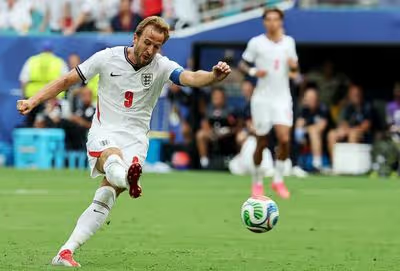
It supplies narrative heat, but the outcome will turn on Declan Rice’s fitness, Harry Kane’s finishing, and how England matches up tactically with Lionel Messi and a seasoned Argentina side.
The Fire Horse angle: why fans are talking 1966 and 2026
The Fire Horse returns every 60 years as the Chinese zodiac cycles elements with animals. 1966, England’s only World Cup win, coincided with a Fire Horse year; 2026 marks the same zodiac combination. That coincidence has provided a feel-good storyline for Three Lions supporters — a cultural omen more than a footballing forecast — and underscores how fans seek meaning in big tournaments.
Why the omen matters emotionally — but not decisively
Superstitions and omens galvanize supporters and can ease pressure on players, but they don’t replace tactics, preparation or individual form. Confidence can be contagious: a nation convinced something special is coming can lift marginal gains. Still, decisive factors remain injuries, gameplans, and moments of quality — the realities that turn narratives into trophies.
Squad update: Declan Rice and England’s midfield balance
Declan Rice was substituted at halftime in England’s recent win after a bout of illness. He isn’t fully fit but has indicated confidence about being available for the Atlanta clash. Rice’s presence matters more than any omen: his defensive shielding and ability to progress the ball are central to England’s plan against a team that can punish turnovers and control tempo.
Harry Kane, Messi and the broader match-up
Harry Kane remains the referent for England’s attack; his finishing and hold-up play shape chance creation. Lionel Messi is rightly the headline for Argentina, but Argentina’s strength is collective — midfield control, mobile attackers and tactical variety. England must limit Messi’s influence while exploiting space in behind Argentina’s lines, a test of discipline and transition play.
Kit talk and history: psychology or distraction?
Argentina’s choice to wear their navy away kit rekindles memories of past meetings — notably 1986 and 1998 — and adds another layer to the narrative duel. Kit history fuels conversation and can feed psychological edges, yet it remains a peripheral storyline. On the pitch, match management and in-game adjustments will matter far more than shirt colour.
What this semi-final means for England’s World Cup hopes
A win in Atlanta would propel England into a final against either France or Spain, placing the team back on football’s biggest stage. The Fire Horse story gives fans a unifying chant, but the true barometer will be whether England can execute a clear tactical plan, keep Rice fit, and harness Kane at his best. If they do, the narrative and the reality could converge.
Bottom line — omen versus execution
The Fire Horse coincidence is a powerful cultural hook that amplifies optimism. As an analyst, the clear takeaway is this: positive narratives help morale, but trophies are won through preparation, adaptability and moments of individual brilliance.
England’s path to lifting a first World Cup since 1966 depends on those tangible factors more than celestial alignment.
 The Sun