


Grant Wahl’s absence is the defining subplot of this World Cup: his widow, Dr. Céline Gounder, says Wahl would have celebrated the spectacle on the pitch while relentlessly interrogating FIFA and political interference — from the Folarin Balogun eligibility reversal to questions about ties between FIFA leadership and U.S. political figures — reminding U.S. soccer that watchdog journalism still matters.
Grant Wahl’s voice casts a long shadow over the World Cup
Grant Wahl’s death at the 2022 World Cup in Qatar continues to reverberate through this tournament. His widow, Dr. Céline Gounder, captures the gulf: Wahl would have been both elated by the tournament’s stars and furious at the off-field machinations that shape outcomes.
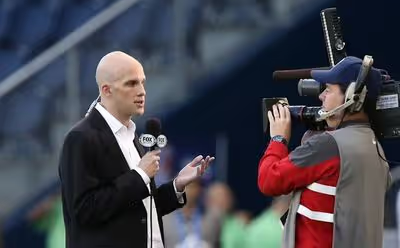
That duality — reverence for the game and refusal to look away from power — is the lens many U.S. fans and journalists now miss.
Why the Balogun episode crystallizes Wahl’s absence
The controversy over Folarin Balogun’s suspension and FIFA’s last-minute reversal epitomizes the kind of hybrid sports-and-politics story Wahl mastered. A red card that should've triggered a ban, then an overturn after a high-level phone call involving FIFA president Gianni Infantino and U.S. political figures, left the U.S. camp and observers scrambling for answers.
Wahl would have pursued the timeline, the decision-making process and the accountability questions that linger after the Belgium match left the U.S. eliminated.
On-field brilliance and off-field scrutiny
Wahl was as likely to break down a Lionel Messi moment or Kylian Mbappé run as he was to interrogate FIFA governance, migrant-worker treatment in Qatar, or how political favors shape the sport. That breadth matters: fans want tactical clarity and storytelling, but the integrity of the game depends on hard reporting when institutions fail. Wahl’s coverage pushed U.S. soccer conversations beyond box scores into policy and human-rights terrain.
How Wahl changed American soccer coverage
Wahl helped professionalize and nationalize soccer coverage in the United States. He treated the sport with intellectual seriousness, pushed long-form feature reporting, and mentored a generation of writers who now file the stories filling press centers and news feeds. The result: more nuanced analysis, deeper tactical literacy among fans, and persistent attention to governance questions that previously slipped beneath mainstream radar.
Mentorship and the media gap
The toughest immediate consequence is less tangible: a mentorship vacuum. Wahl’s ability to toggle between breaking news, long reads and multimedia content set a standard younger reporters emulated. His absence forces outlets and individual journalists to step up, but the loss of a central, trusted voice still reshapes public conversation and the framing of controversial episodes.
The personal toll and the legacy beyond journalism
Wahl died of an undetected ascending aortic aneurysm while covering the World Cup. His death has sparked family-led advocacy for genetic screening and aortic health awareness after his brother discovered a shared mutation. The football world’s tributes — from fan marchers bearing his image to institutional preservation of his papers — show that Wahl’s influence extended beyond match reports to culture and civic memory.
Preserving a record and pushing for change
Wahl’s archive being collected by a national institution cements his place in the story of soccer’s rise in America. That preservation is an implicit judgment: his reporting mattered not only to fans but to cultural historians tracking sport, media and human-rights intersections. At the same time, family-driven work on aortic awareness turns personal tragedy into public benefit — a logical extension of Wahl’s belief in journalism that made a difference.
What this means for U.S. soccer and the World Cup narrative
The tournament will be remembered for moments on the pitch — goals, saves, breakout stars — but Wahl’s absence ensures off-field narratives remain central. Governance issues, refereeing controversies, and political entanglements will continue to shape perceptions of results and legitimacy. For U.S. soccer, the immediate questions are tactical and developmental; for the media, they are structural: who will sustain the watchdog role Wahl embodied?
Where coverage should go next
Newsrooms covering the sport should prioritize the two threads Wahl balanced: meticulous tactical analysis that educates fans, and dogged accountability reporting that protects the game’s integrity. That means maintaining investigative resources, elevating long-form work, and mentoring new voices capable of holding institutions to account without sacrificing the joy of the sport.
Bottom line
Grant Wahl’s distinctive mix of celebration and scrutiny is still shaping how fans interpret this World Cup. His absence is both emotional and practical: the game has its stars on the field, but the long-term health of soccer in the U.S. depends on the kind of principled, probing journalism he practiced.
Mikel Merino's late winner vs Belgium proves Spain's super-sub is a decisive weapon
The tournament’s controversies — from Balogun’s eligibility to broader FIFA questions — are reminders that the story of soccer is never contained by the ninety minutes.
 Yahoo! News


