


Argentina's 2022 World Cup victory — Lionel Messi’s crowning international achievement — reclaimed the nation’s place among football’s elite, delivered Argentina a third title and intensified the GOAT debate, while underscoring a shifting global order as teams prepare for a wide-open 2026 tournament.
2022 World Cup: Messi, Argentina and the lasting impact
Argentina's 2022 triumph rewrote narratives. Lionel Messi, already hailed for club brilliance, now holds the only major international prize that eluded him — a decisive factor in any GOAT conversation. The win gave Argentina its third World Cup and ended a 36-year wait since 1986. For Argentina it was validation of a generation built around Messi’s vision and a balanced supporting cast.
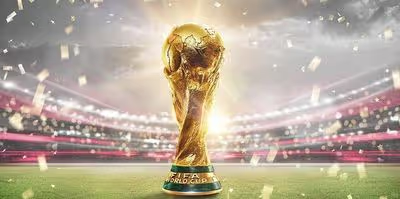
Why this matters
This title matters beyond silverware. It stabilizes tactical credibility for Argentina’s setup, elevates coach and player resumes, and reshapes how opponents prepare for Messi-led sides. For world football, it reinforced the idea that individual brilliance combined with cohesive team structure still wins at tournaments dominated increasingly by depth and physical systems.
Recent champions and the modern cycle
France entered 2022 as defending champions after their 2018 triumph, with Kylian Mbappé emerging as the heir to global stardom. France’s 2018–2022 era showcased rapid squad renewal and tactical flexibility. Germany (2014) and Spain (2010) represent recent cycles where system and youth development sustained extended success — the model other nations study closely.
Complete list of FIFA World Cup winners (1930–2022)
1930 – Uruguay | Runner-up: Argentina | Third: United States
1934 – Italy | Runner-up: Czechoslovakia | Third: Germany
1938 – Italy | Runner-up: Hungary | Third: Brazil
1950 – Uruguay | Runner-up: Brazil | Third: Sweden
1954 – West Germany | Runner-up: Hungary | Third: Austria
1958 – Brazil | Runner-up: Sweden | Third: France
1962 – Brazil | Runner-up: Czechoslovakia | Third: Chile
1966 – England | Runner-up: West Germany | Third: Portugal
1970 – Brazil | Runner-up: Italy | Third: West Germany
1974 – West Germany | Runner-up: Netherlands | Third: Poland
1978 – Argentina | Runner-up: Netherlands | Third: Brazil
1982 – Italy | Runner-up: West Germany | Third: Poland
1986 – Argentina | Runner-up: West Germany | Third: France
1990 – West Germany | Runner-up: Argentina | Third: Italy
1994 – Brazil | Runner-up: Italy | Third: Sweden
1998 – France | Runner-up: Brazil | Third: Croatia
2002 – Brazil | Runner-up: Germany | Third: Turkey
2006 – Italy | Runner-up: France | Third: Germany
2010 – Spain | Runner-up: Netherlands | Third: Germany
2014 – Germany | Runner-up: Argentina | Third: Netherlands
2018 – France | Runner-up: Croatia | Third: Belgium
2022 – Argentina | Runner-up: France | Third: Croatia
Which countries have won the most World Cups?
Brazil — 5 titles (1958, 1962, 1970, 1994, 2002)
Germany — 4 titles (1954, 1974, 1990, 2014)
Italy — 4 titles (1934, 1938, 1982, 2006)
Argentina — 3 titles (1978, 1986, 2022)
France — 2 titles (1998, 2018)
Uruguay — 2 titles (1930, 1950)
England — 1 title (1966)
Spain — 1 title (2010)
Patterns and takeaways
Historic powerhouses — Brazil, Germany and Italy — dominate the trophy table thanks to sustained talent pipelines and tournament DNA. Argentina’s 2022 win shows how elite players combined with pragmatic tactics can break long droughts. France’s repeatability underscores the value of youth development and rotation. The World Cup continues to reward nations that blend elite individuals with adaptable systems.
What this means looking toward 2026
The 2026 cycle opens with questions: Can France and Mbappé restore dominance? Will Brazil or Germany reassert control? Argentina’s victory raises the bar for teams aiming to disrupt established powers. Expect national programs to double down on depth, tactical versatility and succession planning — the ingredients that produce consistent World Cup contenders.
Final analysis
World Cup history is a ledger of eras: individual geniuses, tactical revolutions and national programs maturing into dynasties. Argentina’s 2022 win is both a capstone for Messi and a reminder that tournaments still crown the best blend of talent, leadership and structure.
Pep Guardiola and Jürgen Klopp were the best of rivals
As teams prepare for 2026, the smart ones will study 2022 not just as a headline about Messi, but as a blueprint for building a championship squad.
 Yahoo! News


