


Lionel Messi answered critics with clarity: a three-goal display in Argentina’s 3-0 2026 World Cup opener against Algeria that doubled as a masterclass in understated leadership. Across Barcelona, Argentina and Inter Miami, Messi’s pattern is constant — humility in voice, ferocity in standard — proving elite influence rarely needs volume to be decisive on the biggest stages.
Messi’s hat-trick and the leadership paradox
Lionel Messi’s three goals in Argentina’s opening 3-0 win over Algeria did more than secure three points; they renewed an argument about how greatness leads. The headlines rightly focus on the goals, but the deeper story is how Messi combines extreme technical excellence with a leadership style rooted in example rather than exhortation.
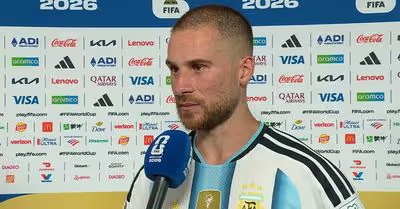
Messi remains measured in public, yet relentless in expectation. That combination forces a reframe: leadership that is quiet is not weak — it’s deliberate and, in his case, devastatingly effective.
Why this performance matters
This match arrived after renewed criticism and questions about whether Messi could carry Argentina again on the World Cup stage. The result was emphatic. A three-goal opener not only answers that particular test but also signals that Messi’s influence on outcomes remains undiminished.
For Argentina, the takeaway is immediate: having Messi in this crucible elevates tactical options and psychological confidence. For opponents, it reintroduces a practical headache — how to slow the game’s central operator without opening space elsewhere.
Context: leadership through three environments
Messi’s leadership is credible precisely because it has been consistent across very different settings.
At Barcelona he led through an intoxicating blend of genius and professionalism, a figure teammates looked to on and off the pitch. With Argentina, early narratives questioned his capacity to captain a national side shaped by vocal personalities and historic expectations. Those doubts faded after the 2021 Copa América and the 2022 World Cup, where his quiet direction translated into tournaments won.
At Inter Miami his approach was the purest experiment: entering a league with different demands and elevated expectations, he chose to integrate rather than dominate. He asked teammates how things worked and then raised standards through daily behavior and intensity in routine drills — turning ordinary moments into competitive benchmarks.
Humility as a tactical device, not a retreat
Reading Messi’s modest public persona as softness misses the point. His restraint is a posture that grants others space while his standards remain uncompromising. That creates a dynamic where teammates are encouraged — and subtly pressured — to meet a level that Messi sets by doing the work himself first.
This is leadership that trades loud directives for an insistence on quality. The result: improved training culture, sustained accountability, and on-field cohesion that can be more enduring than charisma-driven bursts.
Practical lessons for teams and managers
Coaches and leaders outside football can extract clear lessons. First, authority can be exercised through performance and consistency rather than volume. Second, respect earned is more durable than respect demanded. Third, elite influence often comes from the margins — the unglamorous repetitions that define excellence.
On the tactical side, managers facing Messi must balance marking schemes with positional discipline. Double- or triple-teaming him invites spaces for others; leaving him room invites individual brilliance. That dilemma keeps opponents off balance.
What this performance means for Argentina’s World Cup hopes
A dominant opening game sets tone and momentum. Messi’s form creates more than scoring potential; it makes Argentina a center of gravity for opponents’ planning. If he sustains this level, Argentina’s path deep into the tournament becomes more plausible, not because outcomes are predetermined, but because the team benefits from both his finishing and the way his presence sharpens teammates.
How Argentina manages rotation, game state and defensive resilience will still determine the tournament’s arc. Messi’s contributions reduce pressure elsewhere but don’t erase football’s collective variables.
What to watch next
Watch Messi’s minutes management, his involvement beyond final third activity, and how opponents adapt their defensive schemes. Notice whether his quieter leadership continues to elevate marginal players into reliable contributors. The interplay between Messi’s individual moments and Argentina’s systemic coherence will be the central story of their campaign.
Conclusion: leadership beyond narrative
Messi’s recent showing is a reminder that leadership has many dialects. His quiet authority — consistent from Barcelona to the Albiceleste to Inter Miami — is an argument against conflating volume with value.
Pragmatic USMNT win 2-0 over Australia — Freeman heads home, Balogun’s cross leads to own goal
On football’s biggest stage, the most potent influence may still be the one that speaks least but compels most.
 Yahoo! News


