


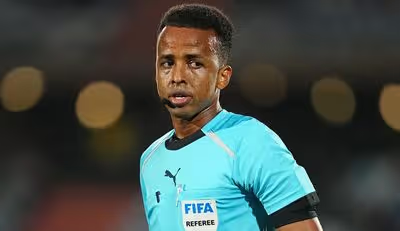
UEFA has appointed Somali referee Omar Abdulkadir Artan to the UEFA Super Cup between Paris Saint-Germain and Aston Villa on 12 August, weeks after US authorities denied him entry for the 2026 FIFA World Cup on alleged security grounds.
Artan to referee UEFA Super Cup after US visa denial
Omar Abdulkadir Artan will take charge of the UEFA Super Cup in a high-profile appointment that doubles as a strong statement from European football. The match pits Champions League winners Paris Saint-Germain against Europa League holders Aston Villa on 12 August.
Fast facts: appointment and context
Artan was included on FIFA’s officials list for the 2026 World Cup but was prevented from entering the United States amid alleged security concerns. Despite that setback, UEFA praised his rapid rise: on the FIFA international list since 2018 and CAF Men’s Referee of the Year for 2025 after key assignments including the CAF Champions League final.
Why UEFA’s choice matters
Selecting Artan for a marquee European showpiece is about more than officiating pedigree. It signals UEFA’s willingness to use marquee fixtures to spotlight referees who have faced public controversy — and to underline values of inclusion and non-discrimination. For Artan, the appointment restores a global platform denied to him at the World Cup and sends a clear message to players, clubs and fans about meritocracy in match official appointments.
Sporting credentials that justify the call
Artan’s CV is compact but impressive: rapid progression through CAF competitions, high‑pressure finals and recognition as Africa’s top referee in 2025. His style — authoritative, mobile and confident managing of big-match dynamics — fits the Super Cup’s intensity, where early control often defines the flow.
Wider fallout: FIFA, visas and tournament readiness
The visa refusal in the United States exposed logistical and diplomatic friction ahead of a transnational World Cup. UEFA’s appointment implicitly rebukes the sidelining of officials on non-sporting grounds and amplifies scrutiny on how global tournaments handle entry and inclusion of match officials, staff and delegations.
What this means for FIFA and stakeholders
For FIFA, the episode complicates messaging about inclusivity and tournament delivery. For refereeing bodies and confederations, it underlines the importance of contingency planning and advocates for clearer, sport-focused protocols when officials travel for major events.
Looking ahead: the match and the narrative
On the field, Artan’s performance will be dissected as any top official’s would — perhaps even more closely given the backstory. Off it, UEFA’s decision has already reframed the narrative from one of exclusion to one of rehabilitation and recognition.
Possible long-term impacts
If Artan manages the Super Cup with authority, UEFA gains credibility for its stance and Artan strengthens his case as a leading global referee. Conversely, any controversial moments will be magnified by the prior visa drama, feeding debate over how much politics should intersect with match appointments.
Bottom line
UEFA’s appointment of Omar Artan is a deliberate, consequential move: it rewards merit, pushes back against a diplomatic snub, and places a referee who was denied a World Cup platform squarely back under football’s brightest lights.
Protests, excitement, cops — 10 photos of World Cup opening ceremony preparations
 Yahoo! News


