


Spain defeated defending champion Argentina in extra time at MetLife Stadium to claim the expanded, three-country World Cup — a tournament that blended chaotic FIFA controversies, commercial excesses and a Super Bowl-sized halftime spectacle with 39 days of genuinely electric fan moments and standout performances from stars like Kylian Mbappé, Lionel Messi and emerging talents such as Jude Bellingham and Erling Haaland.
Spain edges Argentina in subdued final, but the tournament was a fan triumph
Spain beat Argentina in extra time to lift the World Cup in New Jersey, bringing down the curtain on a 48-team spectacle that was as messy off the field as it was memorable on it.
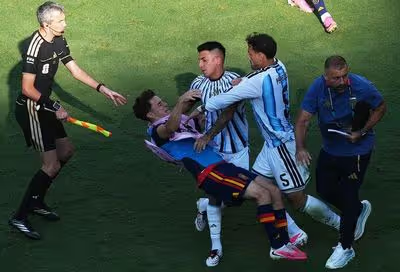
The final itself felt cautious and low on drama, yet it could not erase 103 previous matches filled with breakout stars, tactical intrigue and stadium atmospheres that reminded the sport why it remains the world’s most popular.
Final verdict: a dull cap, a successful tournament
The last match produced fewer fireworks than many expected, but Spain’s win is the headline. The game’s lack of excitement did little to diminish an otherwise expansive tournament that delivered compelling storylines, a fierce Golden Boot race and a broadening of competitive voices thanks to the 48-team format.
Stars and statistics: Mbappé, Messi and the next generation
Kylian Mbappé finished as the Golden Boot winner with 10 goals, underscoring his status as a generational talent. Lionel Messi closed the tournament with eight goals, his World Cup swan song muted by Spain’s final victory. England’s Jude Bellingham and Norway’s Erling Haaland (seven goals each) emerged as the best of the next wave, while Harry Kane and Ousmane Dembélé also left notable marks.
Underdogs and continental strides
Tiny Cape Verde validated the expanded field, opening with a scoreless draw against eventual champions Spain and pushing Argentina in the round of 32. African nations made a statement: nine of 10 qualifiers reached the knockout stage, demonstrating real competitive depth across the continent. All three host countries — the United States, Canada and Mexico — advanced, reinforcing the tournament’s success in engaging diverse fanbases.
Fans, atmosphere and the summer’s lasting images
If the World Cup has a true victor beyond Spain, it is the supporters. From Scotland’s Tartan Army to Norway’s traveling hordes, fans turned host cities into party capitals. Stadium singalongs during hydration breaks became emblematic, and the collective joy of fans checking off a bucket-list experience provided many of the tournament’s richest moments.
Controversies: commercialization, governance and credibility
FIFA’s handling of the event drew consistent criticism. The high cost of tickets and public transit, novel quarter-time formats designed around broadcast needs, and the unprecedented Super Bowl-style halftime spectacle frustrated purists.
Governance issues — including decisions that raised questions about access, officiating and political optics — kept scrutiny firmly on FIFA and its leadership. These controversies matter because they risk eroding trust in tournament stewardship even as the sport’s popularity surges.
What this means for the game
The tension between spectacle and sport was the tournament’s defining theme. Broadcasters and organizers pursued new revenue models and entertainment crossovers, but fan engagement showed the core product — 22 players and a ball — remains irresistible. The challenge for FIFA and host nations is to preserve the World Cup’s integrity while accommodating growth and modern broadcast demands.
Looking ahead: legacy and the next big stage
With the women’s World Cup in Brazil on the horizon, the men’s tournament leaves a mixed legacy: an expanded field that produced drama and inclusivity, and institutional choices that provoked debate. For players like Mbappé, Bellingham and Haaland, the tournament elevated their global standing. For FIFA, the takeaway is clear — deliver the spectacle, but repair credibility if the World Cup is to remain the game’s crown jewel.
What to watch next
Expect scrutiny of governance reforms, debate over tournament formats and continued evolution in how football balances commercial partnerships with on-field purity.
Rodri and Haaland shine while Elliot Anderson injects fresh hope into Man City after World Cup
For fans and players, the immediate future is bright: the sport’s global footprint grew this summer, and the next chapters — both men’s and women’s — promise more high-stakes football.
 Yahoo! News


