


With every 26-man roster locked for the Geopolitics World Cup, the tournament narrative has a new subplot: a high-quality Omitted XI of players left at home. These snubs — from club form casualties to tactical misfits — reveal manager priorities, squad depth questions and a few players who could still reshape the conversation if form or fortune swings their way.
Final squads confirmed — the story beyond the 26
Squads for all 48 teams are now submitted, completing the field for a tournament defined as much by who’s missing as who’s included. Managers have balanced experience, form and tactical fit, producing several eyebrow-raising exclusions that say more about selection philosophies than raw ability.
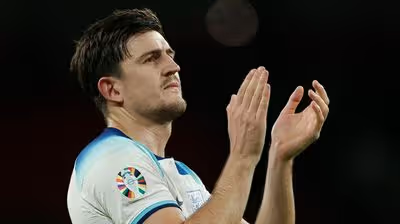
Omitted XI: the best players who didn’t make the trip
Goalkeeper — Lucas Chevalier (France)
Chevalier’s trajectory since his big move has been uneven; losing the starting spot at PSG cost him match rhythm and international favor. France’s depth means talented keepers can be punished for a single poor season — Chevalier is a classic case of timing colliding with expectation.
Right-back — Jeremie Frimpong (Netherlands)
Explosive and productive in attack, Frimpong was hamstrung by a role change at Liverpool that blunted his end product. His omission highlights how modern full-back roles are now judged on tactical nuance as much as raw pace.
Centre-back — António Silva (Portugal)
The 22-year-old’s dip in club and national form came at the worst moment. Beyond form, narratives about off-field issues and managerial trust have dogged him — a reminder that elite potential doesn’t guarantee automatic selection.
Centre-back — Dean Huijsen (Spain)
Huijsen’s allegiance switch hasn’t yet yielded international minutes. With Spain opting for different defensive profiles, the young Dutch-born centre-back finds himself a victim of depth and timing rather than clear failure.
Left-back — Alejandro Balde (Spain)
Balde’s consistent minutes for Barcelona make his absence feel harsh. Spain’s full-back cupboard is deep, but omitting a starter from the La Liga champions underlines how coaches weigh versatility and tactical adherence over reputation.
Central midfield — Adam Wharton (England)
Wharton’s selection debate was driven by stylistic questions: England favored midfielders who fit a specific engine-room profile. For Wharton, the lesson is that promising attributes are sometimes less persuasive than an exact tactical fit.
Central midfield — Eduardo Camavinga (France)
A Real Madrid player with finals experience, Camavinga’s omission is perhaps the tournament’s most telling sign of France’s abundance and a hint that midfield balance — not individual pedigree — won the day.
Central midfield — Diego Luna (USA)
Luna’s breakthrough marketing visibility and solid goal contributions for his country weren’t enough. The US opted for midfield profiles that better suited Mauricio Pochettino’s immediate game plan, illustrating selection preference over star potential.
Right wing — Mika Godts (Belgium)
A 30+ goal contribution season for Ajax would ordinarily guarantee a look; here, tactical fit and managerial conviction trumped raw numbers. Godts is a casualty of a coach prioritizing systemic cohesion.
Left wing — Morgan Gibbs-White (England)
Gibbs-White’s midseason burst made his omission feel personal. England’s wing options present a selection headache: form, fitness and role specificity forced a choice that leans conservative rather than rewarding hot streaks.
Striker — João Pedro (Brazil)
Being one of his club’s standout performers didn’t translate to a national call. For teams like Brazil, creativity up front competes with stylistic templates and the coach’s desire for certain striker archetypes.
What these exclusions tell us
Managers prioritized balance and tactical clarity over headline names. Common themes: players falling out of club favor, positional overcrowding, and coaches who value specific skill sets over form alone. Depth in powerhouses — France, Spain, England — means world-class players can be left behind; for smaller nations, selection swings toward versatility.
Short-term consequences
Selected squads feel safer and more system-ready, but risk being conservative. Injuries or tournament swings of form could reopen doors; managers will watch club performances closely in the weeks before the first whistle.
Long-term consequences
For the omitted, this is a fork: immediate club form can vindicate them, while prolonged absence could stall international careers. For managers, the choices will be judged by results: conservative selection that wins will look prescient; the opposite will invite scrutiny.
Tournament tools, data and fan engagement
Organizers have released a full player database covering all squads, alongside interactive tournament simulators and performance trackers. Those tools make it easier to assess how tactical choices and omissions might influence group dynamics and knockout pathways.
Quote of the day — Ibrahima Konaté
“There are low points, there’s depression. You can suffer from depression in football too; there’s no need to be ashamed to say so.” Konaté’s candour about mental health underlines an often-overlooked human dimension behind high-stakes selection and performance pressures.
Reader snapshot
One reader asked whether a manager should take a high-pressure job at a top club so soon after instability — a reminder that managerial decisions and club politics are as central to football narratives as any eleven on a team sheet.
Bottom line
The final rosters have sharpened the tournament storylines: selection philosophies matter. These snubs are not simply lapses in judgment but the product of tactical design, squad depth and timing. How managers live with these choices will be one of the tournament’s most revealing subplots.
23 Clubs With Most Players at the 2026 World Cup
In today’s Football Daily: a potential Omitted XI for the GWC, and Ibrahima Konaté opens up
 Yahoo! News


