


CazeTV streamed all 104 World Cup matches free in Brazil, peaking at 21.3 million simultaneous viewers during Brazil’s 2-1 win over Japan — one of YouTube’s biggest live audiences. LiveMode has replicated the concept in Portugal with LiveModeTV (backed by Cristiano Ronaldo) and free rights to 34 matches, signaling a shift toward ad-funded, YouTube-first distribution for major football events.
CazeTV’s World Cup experiment: free, massive and live on YouTube
CazeTV, the YouTube channel founded by Brazilian streamer Casimiro Miguel, carried every World Cup match free to Brazilian viewers, tapping into a domestic appetite for accessible football coverage. The channel’s peak of roughly 21.3 million simultaneous connected devices during Brazil’s 2-1 win over Japan made it one of YouTube’s largest live audiences for any sporting event.
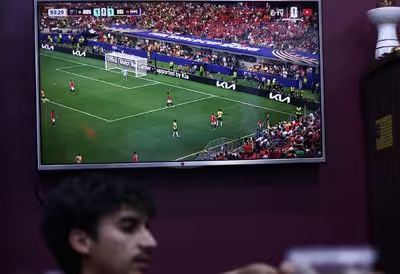
That scale proves demand is real: millions of fans are willing to watch marquee international football on an ad-supported platform rather than traditional pay-TV or subscription apps.
LiveMode’s expansion: LiveModeTV in Portugal and star power
LiveMode, the company behind CazeTV, launched LiveModeTV in Portugal and secured rights to stream 34 World Cup games for free. The Portuguese channel, backed publicly by Cristiano Ronaldo, amassed a substantial audience quickly, underlining the commercial appeal of pairing elite football rights with digital distribution and celebrity endorsement.
This isn’t a one-off distribution tactic; it’s a play for younger, streaming-first audiences who prefer YouTube and social platforms to legacy television.
Why this model matters
Free, ad-funded streaming challenges the paywall status quo. For rights holders, it opens a different pathway to reach mass audiences without relying solely on carriage fees or paid subscriptions. For advertisers, massive live audiences concentrated around national-team games create valuable inventory. For fans, the benefit is obvious: fewer barriers to watching their team.
The model also highlights generational shifts in consumption. Younger viewers are less tethered to cable bundles and more likely to follow content where creators and communities live — and YouTube offers that combination.
Contrast with the U.S. sports landscape
The U.S. market has moved in the opposite direction: rights to NFL, NBA, MLB and NHL content are distributed across multiple paid streaming platforms, contributing to fragmentation and subscription fatigue. Leagues have tested free streaming windows — MLB had a limited YouTube experiment from 2019–2022 and the NFL aired a single game on YouTube recently — but full-channel, sustained free-streaming rights remain rare stateside.
High rights fees, entrenched broadcast deals, and complex bundle economics make a Brazil-style shift harder to replicate immediately in the U.S.
Economics: advertising vs. carriage vs. subscription
Free YouTube channels rely primarily on advertising revenue and sponsorship, not carriage fees or subscriber income. That reduces consumer friction but demands massive viewership to match the revenue that networks extract from pay-TV deals and streaming subscriptions.
If a company can scale consistent, high-value audiences — national-team matches, star players, or popular studio shows — ad-supported streaming becomes viable. The Ronaldo-backed Portugal venture is a signal that talent and branding accelerate audience trust and advertiser interest.
What this means next — for rights holders, platforms and fans
For rights holders: expectations are shifting. Digital-first distribution can extend reach and engagement, particularly in markets where streaming penetration is high and cable is waning.
For platforms: YouTube and similar services are in a position to court live sports rights that deliver appointment viewing at scale. Expect more targeted regional deals rather than global one-size-fits-all strategies.
For fans: the Brazilian model offers a blueprint for lower-cost access to high-profile football. If it proves sustainable commercially, more federations or rights owners may explore ad-funded channels to win back viewers priced out by subscription stacking.
Outlook and limits
The Brazil and Portugal cases are persuasive but not universally transferable overnight. Rights fees, regulatory landscapes, and legacy broadcast relationships vary by market.
Balogun fined $40,000 as FIFA lifts suspension — Belgium threatens CAS over red card
Still, the principle is clear: when you put national-team football where the audience already congregates, you unlock scale — and potentially reshape how major competitions are packaged and monetized.
 Yahoo! News


