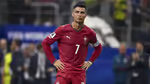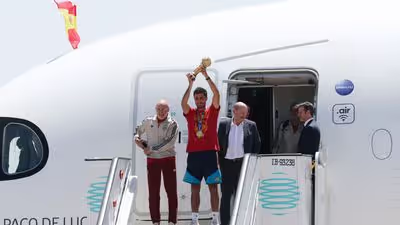
Breaking: Rodri, Manchester City's World Cup standout, reportedly favors a return to Real Madrid despite a new contract extension on the table at City; Real are internally divided and club president Florentino Pérez is the key obstacle as Madrid weighs replacing Luka Modrić in midfield.
Rodri’s stance and contract picture
Rodri, the Manchester City defensive midfielder and recent World Cup standout, remains open to a move back to Spain even though his current City contract runs to June 2027.
Manchester City have presented a new extension proposal that would keep him at the Etihad, but the player’s preference for a Real Madrid switch is clear.
Form and fitness context
The 30-year-old returned from a torn ACL suffered in September 2024 and managed 17 starts in 2025–26, showing enough quality to rekindle interest from Madrid. His World Cup performances elevated his profile and intensified Madrid’s internal discussions about targeting him.
Real Madrid’s internal debate
Real Madrid are reportedly revisiting the idea of signing Rodri as they plan beyond Luka Modrić, whose departure has left a midfield void. A portion of the club’s hierarchy favors pursuing Rodri for his control, positional intelligence, and ability to dictate tempo.
Why Florentino Pérez matters
Despite board-level interest, Florentino Pérez appears hesitant to greenlight the move. Pérez’s position historically determines Madrid’s big signings, and his reluctance is the single biggest roadblock. That dynamic has transformed what might have been a straightforward pursuit into a delicate boardroom decision.
What this would mean for Manchester City and Real Madrid
For Manchester City, keeping Rodri secures continuity in their midfield spine and removes the need to search for a like-for-like midfield anchor. Losing him would force City to accelerate succession planning.
For Real Madrid, Rodri would offer a modern replacement for Modrić: less about flashy late runs and more about territorial control, pressing intelligence, and distribution from deeper positions. His signing would shift Madrid’s midfield profile toward structure and balance.
On-field fit and tactical implications
Rodri’s strengths—positional discipline, interception ability, and long-range passing—fit both Pep Guardiola’s possession model and Madrid’s need for a stable pivot to shield a high defensive line. At Madrid, he would likely partner with a more progressive midfielder, altering rotation patterns and pressing triggers.
Next steps and likely scenarios
City will press their contract offer and make the case for continuity; Madrid must resolve the internal split and get Pérez on board if they are to move. Realistically, either a compromise that satisfies Pérez or renewed momentum at the board level will determine whether talks advance.
If Madrid do not act, Rodri is expected to remain at City and continue as a central figure. If they do, this would be one of the summer’s headline transfers and a clear signal of Madrid reshaping the spine of their team.
Why it matters
This is not just a transfer tussle: it’s a strategic crossroads for two elite clubs. For City, it’s about preserving a hallmark of their success; for Madrid, it’s an opportunity to modernize the midfield after Modrić.
Boca weigh fitness and discipline as Leandro Paredes seeks spot after World Cup row
The outcome will influence tactical approaches and squad planning at both clubs.
 Yardbarker