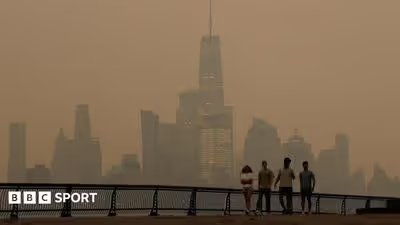
Wildfire smoke from Canadian blazes has prompted an air quality health alert across New York and New Jersey days before the World Cup final at New York New Jersey Stadium, raising concerns for players, some fans and a high-profile halftime show as organizers monitor conditions closely.
Wildfire smoke prompts air quality alert ahead of World Cup final
Officials have issued an air quality health alert across New York and New Jersey as haze from Canadian wildfires drifts into the region just days before the World Cup final between Spain and Argentina at New York New Jersey Stadium in East Rutherford.

The alert urges residents to reduce outdoor exertion and remain indoors where possible, a message that immediately shifts the risk calculus for an open-air event expected to host more than 80,000 spectators.
Immediate implications for teams and match logistics
Spain has already arrived and completed an outdoor session, appearing outwardly unaffected. Argentina remained in Georgia after their semi-final and planned to resume training in New Jersey on Friday afternoon.
New York New Jersey Stadium is an open-air venue, so organizers and team medical staff will be watching the air quality index closely in the run-up to kickoff. At present there is no official indication the final itself will be postponed or moved, but the alert intensifies pressure on contingency planning for player health and fan safety.
Player experiences underline the concern
Players and performers have felt the effects. A contractor with a daughter rehearsing at the stadium described heavy, hard-to-breathe air. The National Women’s Soccer League already navigated smoky conditions in a recent match at Citi Field, where league policy required players to take additional breaks.
Washington Spirit’s Trinity Rodman described the atmosphere after that game as “rough,” saying in her view the match should not have gone ahead. Such firsthand accounts matter for elite-level football, where fine margins of endurance and recovery can influence performance.
Why this matters and what could change
Smoke and poor air quality are more than an inconvenience: they can impair breathing comfort and recovery during high-intensity exercise, and they complicate logistics for tens of thousands of spectators and a major halftime production.
Organizers will be balancing the championship’s commercial and sporting imperatives with public-health guidance. The most likely near-term outcome, based on current forecasts, is continued monitoring rather than disruption — but conditions remain fluid.
Forecast outlook and next steps
Models expected modest improvement by Friday, with forecast rain on Saturday likely to help disperse smoke ahead of Sunday’s final. That meteorological window, if it materializes, would significantly reduce immediate concerns.
Teams, venue operators and health officials will need to remain coordinated. If air quality worsens, expect tightened mitigation measures: restricted outdoor activity for non-essential personnel, updated guidance for fans, and possible adjustments to training locations.
Bottom line for fans and stakeholders
At the moment the World Cup final remains scheduled as planned, but the air quality alert is a live issue that could influence preparations for players, performers and spectators.
Tuchel's controversial call: why Kobbie Mainoo watched England's World Cup from the bench
The coming 48 hours will be decisive — improvement brings relief; persistence of the haze would force starker choices about safety and operations.
 The Bbc