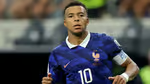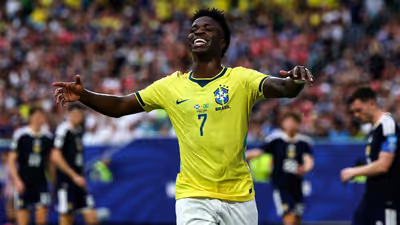
Monday’s slate feels like the true start of the World Cup knockout grind: three high-stakes fixtures — Brazil vs Japan, Germany vs Paraguay and Netherlands vs Morocco — that will redefine title trajectories. Brazil ride Vinicius Junior’s red-hot form while Germany face a tactical choice over Joshua Kimmich’s role. Results here won’t just decide who advances; they’ll reshape momentum, tactical narratives and the shortlists of genuine contenders.
Knockout-day overview: three matches that matter
Brazil vs Japan headlines a day that finally feels like the tournament’s competitive engine kicking into gear. Germany get a chance to impose themselves against Paraguay, and the Netherlands must avoid the kind of shock Morocco produced in 2022.
These games are less about group-stage padding and more about which teams have the depth, structure and killer instincts to tilt a knockout draw.
Brazil vs Japan — Vinicius Junior’s moment
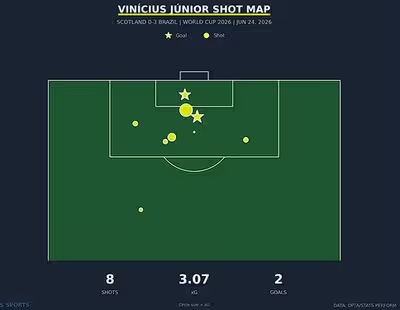
Vinicius Junior has arrived at this World Cup with a different profile to his earlier international outings. Club form at Real Madrid under Carlo Ancelotti long promised a player who can decide elite games; Brazil’s recent setup has begun to turn that club promise into international production. Two goals against Scotland from 3.07 expected goals and incisive penalties in previous matches underline a forward operating at peak confidence.
How Brazil are unlocking him
Coach has leaned on a formation that allows Matheus Cunha to function as a false nine, dropping to pull defenders out of position and open lanes for Vinicius to exploit in-behind. That spatial manipulation, combined with precise passing from areas like Lucas Paquetá, has let Vinicius isolate fullbacks and attack transition moments. Against Japan, who defend with speed and structured pressing, Brazil’s task is to sustain those transitions and prevent quick counter-presses from nullifying Vinicius’s space.
Why it matters
If Vinicius sustains this level in knockout intensity, Brazil’s attacking profile shifts from a star-reliant threat to a multi-headed offense with genuine cutting power. That elevates Brazil from clear favorites to overwhelming ones — provided the defence remains compact and midfield protects transitions. For Vinicius personally, consistent knockout performances would finally cement a place in Brazil’s pantheon beyond club exploits.
Germany vs Paraguay — the Kimmich conundrum
Germany’s draw against Ecuador exposed the tension in Joshua Kimmich’s deployment. The former Bayern right-back turned central midfielder still offers elite ball progression and chance creation, but his positioning can be exploited by direct, infield runners. Paraguay presents a test where one defensive lapse can be decisive; margin for error narrows in knockout contexts.
Positional trade-offs
Playing Kimmich high and wide yields attacking returns — he ranks among Germany’s most progressive passers and creators. But when he drifts into quasi-defensive roles or is pulled out of zone, it invites exploitation down channels. Germany’s left-back selection and inverted full-back strategies have sometimes forced Kimmich into a third center-back slot, diluting his creative influence and exposing transition vulnerabilities.
Potential adjustments and consequences
Nagelsmann faces a clear choice: preserve Kimmich in a freeing, offensively productive role and accept a defensive reshuffle, or protect the defensive spine by bringing in more orthodox defensive coverage at the expense of some attacking intelligence. The squad looks light on natural right-back alternatives, so short-term improvisation — whether shifting a center-back into a hybrid role or reassigning a midfielder — is likelier than wholesale personnel change. That will test Germany’s tactical flexibility and bench depth.
Netherlands vs Morocco — avoiding a 2022 redux
The Netherlands arrive aware of the moral: underestimating compact, counter-ready opponents costs trophies. Morocco’s 2022 run is a template for disciplined, defensively resilient teams upsetting headline names. Netherlands must combine assertive possession with sharper guard against transitional counters if they are to avoid an early upset and continue their own promising group-stage momentum.
What to watch and what comes next
Key indicators over the next 90 minutes will be transition control, how teams manage wide attackers, and whether managers are willing to sacrifice short-term ball progression for defensive security. Vinicius’s ability to influence high-stakes minutes will tell us whether Brazil’s tournament is front-loaded with genuine contender form. Germany’s handling of Kimmich will reveal whether they can marry creative ambition with knockout pragmatism.
Big-picture implications
These matches will do more than decide immediate progression: they’ll redefine perceived favorites, force tactical trend adjustments across the bracket, and highlight which squads can adapt under pressure.
Expect managers to prioritise risk management over stylistic purity as the tournament’s business end approaches.
 Cbssports