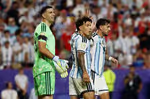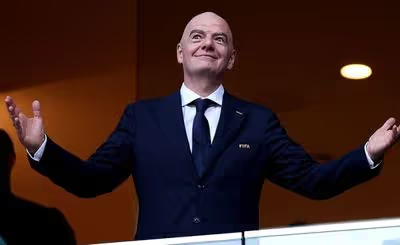
Breaking: Gianni Infantino insists he will remain FIFA president and seek re‑election despite mounting calls to resign after Donald Trump’s intervention in a disciplinary ruling that cleared Folarin Balogun to play — a decision that has ignited integrity concerns following the United States’ 4-1 defeat to Belgium.
Infantino digs in as World Cup disciplinary storm grows
Gianni Infantino has made clear he will not step aside amid fresh controversy over the handling of a World Cup red‑card suspension involving U.S. striker Folarin Balogun. The suspension was controversially lifted after President Donald Trump said he had asked Infantino to review the incident, a move critics say breaches FIFA’s rules on third‑party interference and undermines the tournament’s integrity.
What happened on the pitch
Balogun’s one‑match ban — given after a red card in the last‑32 win over Bosnia — was suspended, allowing him to start in the U.S. last‑16 tie against Belgium in Seattle. Belgium rejected an appeal related to the ruling, then dismantled the hosts 4-1, rendering the disciplinary debate moot in sporting terms but explosive off the field.
UEFA condemnation and the integrity argument
UEFA publicly denounced FIFA’s intervention, saying the decision “crossed a red line” and warning that selective application of clear rules threatens the credibility of competitions. That critique cuts to the core of the controversy: automatic suspensions after red cards are meant to be non‑discretionary, and making exceptions mid‑tournament creates a dangerous precedent.
Governance implications for FIFA
FIFA’s statutes strictly prohibit political meddling in national associations. Critics argue that even the perception of external influence weakens governance and fuels distrust among European federations already wary of Infantino’s tenure. FIFA recently suspended Nepal for third‑party interference, a reminder of the body’s own rules and the inconsistency now being spotlighted.
Infantino’s re‑election prospects
Despite the backlash, Infantino enjoys substantial support outside Europe, notably in Africa and South America — blocs that historically shape FIFA elections. He has declared his intention to run in the next presidential election, which would extend his term to 2031 if successful. Given the global voting dynamics, his re‑election remains likely unless the controversy translates into a coordinated withdrawal of support.
Why this matters beyond one match
This episode is more than a single disciplinary decision; it raises systemic questions about transparency, equal treatment and the separation between football governance and political influence. If FIFA allows exceptional adjudications under external pressure, federations and fans may reasonably ask whether rules apply uniformly or selectively, eroding trust in outcomes and the organisation’s leadership.
What could happen next
Expect intensified diplomatic and legal scrutiny: formal complaints, demands for independent reviews, and renewed calls for clearer safeguards against third‑party interference. UEFA’s vocal criticism increases pressure on FIFA’s ethics and governance apparatus to respond decisively.
For Infantino, the immediate risk is reputational damage; the longer‑term risk is institutional — a widened split between European bodies and the wider membership that could complicate his path to 2027 re‑election.
Bottom line
A high‑stakes World Cup exit has been eclipsed by a governance crisis. Whether FIFA can repair the perception of impartiality will shape not just the remaining tournament narrative but the organization’s credibility heading into the next presidential race.
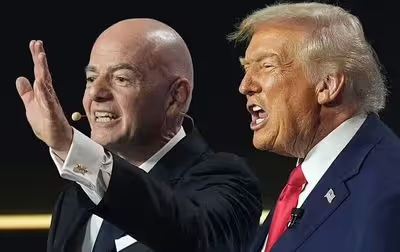
Gianni Infantino is under mounting pressure due to his relationship with Donald Trump.
 Express