All 48 World Cup 2026 squads are final and FIFA published official heights for all 1,248 players, exposing stark physical contrasts across the tournament. Norway and Bosnia lead as the tallest sides (187.2cm), while Saudi Arabia and Argentina rank among the shortest — a factor that will shape set-pieces, aerial battles and tactical matchups as teams collide across the United States, Mexico and Canada.
World Cup 2026 squad heights: headline findings
FIFA’s height list for every player reveals clear patterns: the tallest squads are overwhelmingly European, with Norway and Bosnia topping the chart at 187.2cm. At the other end, Saudi Arabia (178.4cm) and Argentina (179.7cm) sit near the bottom. These are not just curiosities — average team stature will influence free-kicks, corners and defensive planning from the opening whistle.

Tallest teams and what they gain
Norway and Bosnia: aerial advantages
Norway and Bosnia lead the tournament on pure height, each averaging 187.2cm. Norway’s frontline — with Erling Haaland (195cm), Alexander Sørloth (196cm) and Kristoffer Ajer (198cm) — presents a nightmare for zonal marking on set-pieces. Bosnia’s centre-back Stjepan Radeljic (201cm) gives them elite defensive reach.
Europe’s physical cohort: Sweden, Belgium, Czechia and more
Sweden (186.2cm), Belgium (185.8cm) and Czechia (185.7cm) sit among the tallest squads, offering coaches clear templates for direct play and dominance in aerial duels. Teams with that profile can control second balls and pose consistent threats from crosses and long throws.
Shortest squads and how they compensate
Argentina and the compact model
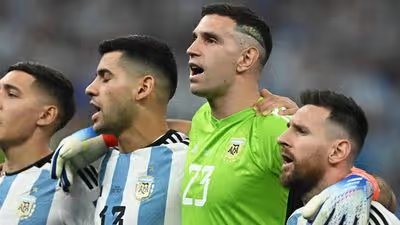
Argentina average 179.7cm, the fifth-shortest squad, yet their global-class technical players — Lionel Messi (170cm) and Julián Álvarez (170cm) — have always compensated with movement, pressing and low-center-of-gravity control. A shorter side often favors quick passing, rapid transitions and low blocks that frustrate taller, less mobile opponents.
Saudi Arabia, Mexico and other smaller sides
Saudi Arabia are the smallest on average (178.4cm), followed by South Africa, Qatar and Mexico. Smaller squads often emphasize speed, agility and technical pattern play rather than aerial superiority, which can unsettle teams that overcommit to long balls.
Mid-table and favourites: mixed profiles
Spain (181.7cm) and Portugal (181.5cm) are relatively compact, while France (184.9cm) and England (184.2cm) are larger. England’s selection — including Dan Burn (201cm) — reflects Thomas Tuchel’s preference for physicality alongside technical players. France and Netherlands (184.9cm) blend height with technical depth, giving them tactical flexibility.
Standout individual measurements
Florian Wiegele (Austria) is the tournament’s tallest player at 205cm, an outlier who changes set-piece calculus. Several players share joint-second tallest status at 201cm: goalkeeper Álvaro Montero (Colombia), Stjepan Radeljic (Bosnia) and others, while Dan Burn (England) and goalkeeper Alisson Becker (Brazil, 193cm) underscore how individual size can swing matchups. At the other extreme, Panama’s César Yanis (160cm) and a handful of sub-165cm players offer different tactical tools — low center of gravity, agility and rapid close control.
Why these numbers matter tactically
Height shapes match plans without dictating outcomes. Taller teams enjoy advantages on set-pieces, central aerial duels and defending long balls. Shorter teams often press higher, play quicker combinations and exploit spaces in behind tall but less nimble defenses. Coaches will map these profiles into specific training — rehearsed zonal vs. man marking at corners, targeted crossing strategies and personnel tweaks for late-game substitutions.
What this means for the favourites and underdogs
Teams like Norway and Bosnia can weaponize their height to unsettle favorites, particularly in knockout settings where set-pieces decide tight contests. Conversely, elite technical sides such as Spain and Argentina will rely on possession control and transitional speed to neutralize aerial threats. The interplay between stature and style creates tactical chess matches that could decide crucial knockout ties.
Looking ahead: tactical battles to watch
Matchups that juxtapose extreme profiles — Norway vs. Spain, Bosnia vs. Argentina, tall Belgium against quick Panama-style opponents — are the fixtures to monitor for tactical innovation. Coaches who adapt set-piece schemes and in-game substitutions to the height profile of opponents will gain measurable advantages.
Bottom line
Height statistics add a tangible layer to World Cup 2026 analysis: they won’t determine winners alone, but they will shape game plans, substitution patterns and the flow of matches.
Where direct communication between Man City and Real Madrid has left Rodri transfer
Expect managers to use this data pragmatically — exploiting mismatches and neutralizing opponents’ physical edges as the tournament unfolds.
 Givemesport