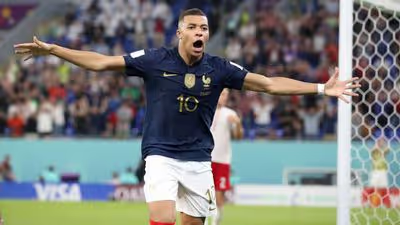
Just Fontaine’s astonishing 13-goal haul at the 1958 World Cup remains the single-tournament scoring benchmark, standing head and shoulders above later campaigns. Modern stars like Kylian Mbappé and Lionel Messi produced memorable tallies in 2022, but Fontaine’s record — built in six matches — still feels untouchable amid contemporary tactics and defensive depth.
Top World Cup single-tournament scoring performances — the definitive list
Why this list matters
Football history rewards individual explosions of scoring; these campaigns shaped tournaments, trophies and legacies. This roundup ranks the highest goal tallies in a single World Cup, explains the context of each run, and offers brief analysis on why some feats feel unrepeatable in the modern era.
12–9: Early legends and modern talismans (7 goals)
12. Leônidas — Brazil, 1938 — 7 goals
Leônidas da Silva electrified 1938 with seven goals in four matches, including a hat-trick against Poland. His tally was corrected by FIFA later, but it still underlines a player who changed how forwards combined athleticism and flair.
11. Jairzinho — Brazil, 1970 — 7 goals
Jairzinho scored in every match as Brazil won the 1970 World Cup — six goals across six games that helped define one of the greatest teams ever. His consistency highlighted the value of a forward who blends finishing with relentless work rate.
10. Grzegorz Lato — Poland, 1974 — 7 goals
Lato’s seven goals powered Poland to third place in 1974, a career peak that emphasized his pace and opportunism. It remains Poland’s finest World Cup attacking display.
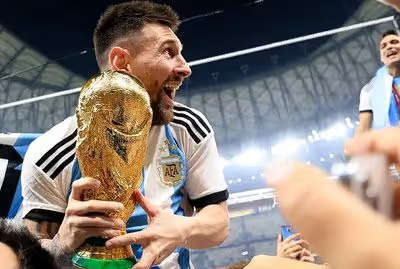
9. Lionel Messi — Argentina, 2022 — 7 goals
Messi’s seven at Qatar 2022 were less about volume and more about leadership: decisive goals in knockout rounds and a brace in the final sealed his Ballon d’Or-level tournament performance and the World Cup trophy.
8–6: Eight-goal campaigns that swung tournaments
8. Guillermo Stábile — Argentina, 1930 — 8 goals
Stábile’s eight goals at the inaugural World Cup made him the tournament’s top scorer and an early icon. His output came in a very different era, but it established Argentina’s attacking pedigree from the start.
7. Ronaldo — Brazil, 2002 — 8 goals
Ronaldo’s eight goals in Korea/Japan redeemed a painful 1998 finale and propelled Brazil to a fifth title. His blend of power, movement and clinical finishing made him the tournament’s standout striker.
6. Kylian Mbappé — France, 2022 — 8 goals
Mbappé’s Golden Boot-winning eight included a final hat-trick in a 3–3 thriller with Argentina. His 2022 campaign demonstrated how a generational forward can still alter the script, even if his team ultimately lost the trophy.
5–1: Double-digit campaigns and the enduring record
5. Ademir — Brazil, 1950 — 9 goals
Credited with nine goals in the 1950 World Cup, Ademir powered a host nation campaign that ended in heartbreak. Historical data from that tournament is patchy, but his dominance in front of goal is undisputed.
4. Eusébio — Portugal, 1966 — 9 goals
Eusébio exploded onto the 1966 stage with nine goals to win the Golden Boot. His four-goal quarterfinal and decisive finishes carried Portugal to a strong finish and cemented his status as one of the all-time greats.
3. Gerd Müller — West Germany, 1970 — 10 goals
Müller’s ruthless finishing produced 10 goals as West Germany finished third. His hat-tricks and clutch extra-time winner against England showcased a striker with an unmatched predatory instinct.
2. Sándor Kocsis — Hungary, 1954 — 11 goals
Kocsis netted 11 in Switzerland 1954, including seven before the knockout phase — an astonishing group-stage haul. His campaign highlighted Hungary’s attacking excesses in an era of open football.
1. Just Fontaine — France, 1958 — 13 goals
Fontaine’s 13 goals in six matches at Sweden 1958 remain the single-tournament World Cup record. Four goals in the third-place match and consistent finishing through the tournament created a statistic that has stood for decades and become footballing lore.
Analysis: Why Fontaine’s record is so hard to beat
Modern international tournaments are more tactical, defensively organized and physically demanding. Teams prepare exhaustively for known threats, reducing the chances for one player to dominate across multiple opponents. Fontaine’s figure benefited from the era’s scoring patterns and tournament format, but it also required extraordinary efficiency — a combination that remains rare.
What recent campaigns tell us
Mbappé’s and Messi’s 2022 performances prove top-level forwards can still dominate, but even elite modern players often split responsibility in deeper, more structured sides. Exceptional individual tournaments still swing outcomes, but they rarely translate into records of Fontaine’s magnitude.
Conclusion: Records, context and what to watch next
This ranking celebrates both historical giants and contemporary stars. Fontaine’s 13 is a high-water mark shaped by its time and the player’s ruthless finishing.
Watch for future tournaments where tactical shifts, a forward’s red-hot form and tournament circumstances might produce another standout campaign — but breaking 13 will remain a monumental ask.
 Si
Si