


These are the 26 players most likely to shape the 2026 World Cup: established superstars chasing legacy, high‑ceiling youngsters primed to break out, and seasoned veterans on final runs. Fitness, form and tactical fit — from Jude Bellingham and Lionel Messi to Erling Haaland, Lamine Yamal and Cristiano Ronaldo — will determine which names dominate this tournament.
2026 World Cup — players who can decide the tournament
Jude Bellingham arrives as England’s fulcrum; his ability to link midfield and attack makes him indispensable if England are to finally end a long World Cup drought. Lionel Messi remains the heartbeat of Argentina despite age and recent hamstring fatigue; his MLS form raises questions about sharpness but not influence.
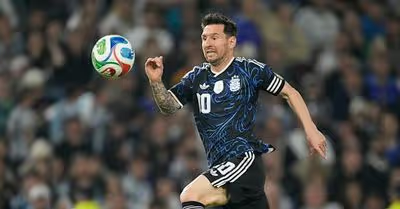
Kylian Mbappé is France’s primary threat on the break; managing his defensive work-rate will be as important as exploiting his elite speed. Erling Haaland, a World Cup debutant, gives Norway a genuine match-winner; his presence alone reshapes opponent tactics.
Established stars chasing legacy
Harry Kane — England
Kane’s lethal finishing at Bayern Munich makes him a tournament favorite to score heavily. England’s tactical tweaks to create space for Kane will be a defining storyline.
Lionel Messi — Argentina
Messi can still tilt big matches single-handedly. Managing minutes and hamstring risk is Argentina’s tactical puzzle; his presence elevates teammates.
Cristiano Ronaldo — Portugal
Ronaldo’s sixth World Cup is a narrative about longevity. The glaring statistic remains his lack of knockout goals; how much Portugal actually play through him will shape his legacy here.
Mohamed Salah — Egypt
Salah’s dip in club form is concerning but Egypt’s group is winnable. A healthy Salah still offers match-defining moments.
Bruno Fernandes — Portugal
Fernandes is Portugal’s creative backbone. If Portugal’s attack functions through him, Ronaldo benefits — otherwise Portugal risk stalling in the knockout rounds.
Young stars and breakout candidates
Jude Bellingham — England
Bellingham’s combination of drive, timing and goal threat makes him a true tournament centerpiece. England’s progression hinges on his ability to dominate central areas while linking to wingers.
Lamine Yamal & Pedri — Spain
Spain’s midfield and attack flow through Pedri and the prodigious Lamine Yamal. Yamal’s hamstring issue could limit early minutes, but his mere involvement forces defenses to adjust.
Arda Güler — Türkiye
Güler’s creativity and Real Madrid pedigree give Türkiye an X-factor in a tricky Group D. He’s the type of talent that can carry an underdog deep.
Jeremy Doku — Belgium
Doku’s directness creates overloads on the flank. With Belgium aging up front, Doku must shoulder the creative and penetration burden.
Veterans on final World Cup runs
Luka Modrić — Croatia
Modrić’s role has shifted from engine to strategist, but his passing and tempo control keep Croatia among the contenders for another deep run.
Edin Džeko — Bosnia‑Herzegovina
At 40, Džeko’s positioning and finishing make Bosnia a realistic knockout contender. His experience elevates an otherwise young attack.
Raúl Jiménez & others — Mexico
Jiménez offers leadership and finishing; Mexico will need his instincts if they are to convert favorable group chances into progress.
Fitness and availability — tournament-defining questions
Alphonso Davies’ hamstring status is pivotal for Canada; his speed and versatility transform Jesse Marsch’s options when fit. Lamine Yamal and Lionel Messi are both managing soft-tissue concerns — Spain and Argentina could be forced into early conservation. Kylian Mbappé’s knee confusion earlier in 2026 raised tactical questions but not his raw threat.
Dark horses and tactical wildcards
Moisés Caicedo — Ecuador
Caicedo anchors an Ecuador midfield that defended excellently in qualifying. Ecuador’s discipline and midfield balance make them a dark horse.
Achraf Hakimi — Morocco
Hakimi’s recovery from injury matters; Morocco’s compact structure and fullback speed were key to their 2022 run and remain a tactical blueprint.
Federico Valverde — Uruguay
Valverde must shoulder Uruguay’s engine role. If teammates like Darwin Núñez provide clinical finishing, Uruguay can surprise the traditional powerhouses.
Vinícius Júnior — Brazil
Vinícius is Brazil’s primary goal threat but has underperformed internationally. Anand Carlo Ancelotti’s coaching influence could unlock a higher output for Brazil.
Key midfield matchups to monitor
Joshua Kimmich’s versatility gives Germany tactical flexibility, yet he is likely to occupy right back, which limits Germany’s midfield creativity. Bruno Fernandes vs. Pedri vs. Bellingham describes a midfield axis that will decide possession battles in pivotal matches. Christian Pulisic’s form for the United States is a barometer for how far the hosts can go; his club struggles need reversing.
What this list means for the tournament
These 26 names form a cross-section of narratives: legacy chases, breakout potentials, injury-managed superstars and tactical fulcrums. Form and fitness will prune this list quickly; those who peak in the first two group games will force their managers to build teams around them. Expect the tournament to reward players who combine durability with tactical discipline — raw talent alone won’t be enough.
Final read: how to watch
Focus early on minutes and roles. Which stars start and for how long will reveal tactical intent. Watch teams that can adapt mid-tournament; the most successful sides will find ways to protect flagged players while extracting maximum influence.
The World Cup has long been a place where players make their name and earn big moves
By the knockout stage, this list will shrink into a handful of defining performers — the names above are most likely to be those who matter.
 Yahoo! News


