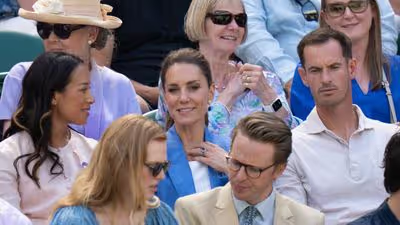
Andy Murray says he has no regrets about competing in the era of Roger Federer, Rafael Nadal and Novak Djokovic, arguing the challenge shaped his career more than it diminished his legacy. A three-time Grand Slam champion, two-time Olympic gold medallist and 46-time ATP winner, Murray now views those epic rivalries as defining moments. Since retiring after the 2024 Paris Olympics he’s moved into coaching, most recently partnering with Jack Draper during the grass swing.
Murray refuses to rewrite history: proud of fighting the 'Big Three'
Andy Murray accepts that Federer, Nadal and Djokovic limited his trophy haul, but he rejects the idea that his career should be measured against hypothetical eras. He acknowledges he might have won more Grand Slams of tennis without those three, yet insists the experience of facing them on sport’s biggest stages is part of what makes his record meaningful.
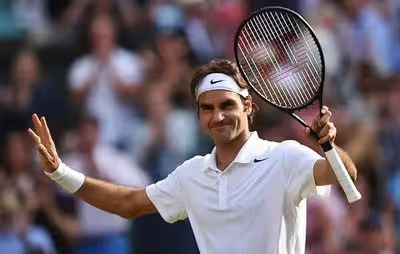
His CV is substantial: three Grand Slam titles (2012 US Open, Wimbledon 2013 and 2016), 46 ATP singles crowns, 14 Masters-level titles, the 2016 ATP Finals, two Olympic gold medals and a pivotal role in Great Britain’s 2015 Davis Cup triumph. He reached 11 major finals, losing eight — five to Djokovic, three to Federer — and emerged as the consistent challenger in an era dominated by the trio.
Pressure, perspective and the Wimbledon story
Wimbledon was both burden and proving ground. Each year without a title increased the scrutiny; Federer’s and Djokovic’s dominance at the All England Club left narrow windows for challengers. Murray has described the pressure of those moments, admitting there were times he wished the three greats were not contemporaries — but he also stresses the upside.
Beating Djokovic on Centre Court, taking on Nadal at Roland-Garros and defeating Federer in an Olympic final aren’t consolation prizes. They are headline wins that underscore Murray’s ability to raise his game against the very best. That combination of near-misses and landmark victories tells a fuller story than raw Grand Slam totals.
Legacy: the best of the rest or integral member of a golden era?
Labeling Murray simply as the “best of the rest” understates his role within one of men’s tennis’ richest stretches. His longevity, tactical intelligence and physical resilience allowed him to challenge — and at times beat — the dominant trio across surfaces. That consistency cemented his status not just as a foil but as a headline actor in matches that defined an era.
From a legacy standpoint, competing against Federer, Nadal and Djokovic has dual effects: it capped the number of major titles he might have amassed, yet it amplified the significance of his victories and the toughness required to attain them. Murray’s frank acceptance of both facts reframes his career as a testament to resilience rather than a saga of missed chances.
Why this matters for how we judge champions
The way generations are compared matters. Counting trophies is clean but reductive; context — opponent strength, injuries, surfaces — alters the frame. Murray’s story pushes analysts to value peak performances, head-to-head battles and the mental grind of repeatedly challenging all-time greats. His career becomes a case study in how elite competition can simultaneously limit and elevate a player’s standing.
From elite competitor to coach: influence on the next wave
Since retiring after the 2024 Paris Olympics, Murray has dipped into coaching. A short stint assisting Novak Djokovic was followed by work with Jack Draper during the grass season. Their collaboration produced a run to the Eastbourne semi-finals, a useful stopgap as Draper rebuilds match fitness and sharpness.
Murray’s transition is logical: technical acumen, tactical patience and the experience of managing pressure at the highest levels translate well to mentoring. His input on movement, match planning and mental preparation can be particularly valuable for British tennis, where a new generation hopes to close the gap to the sport’s elite.
What Murray can do for Draper and British prospects
Murray’s hands-on experience navigating tight margins against top opponents is an asset. For Draper, short-term goals include regaining form on grass and translating that rhythm into the North American hard-court swing. Long-term, Murray’s guidance could accelerate Draper’s return to contention and provide a template for other young British players to handle expectation and injury management.
Outlook: legacy, mentorship and the next chapters
Andy Murray’s verdict on his era is both clear-eyed and proud. He refuses to trade the intense competition of his playing days for hypothetical extra trophies. Instead, he emphasizes the memories, the unique matches and the career-defining moments that came from facing the greatest trio in men’s tennis.
Van Dijk sits beside Louis Theroux as Fery's net-cord protest sparks Centre Court debate at Wimbledon
As Murray shifts to coaching and mentorship, his legacy will be measured not only by past titles but by the players he helps develop and the standards he instils. For British tennis, that influence may be as important as any headline victory he recorded.
 Yardbarker